
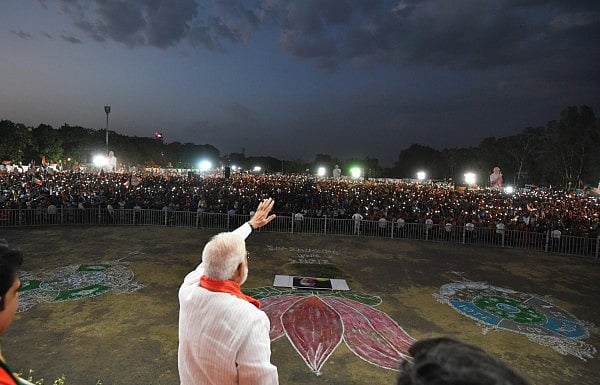
In Varanasi recently, I took an auto-rickshaw from Godowlia to Assi Ghat. Like everyone else in town, the driver and I began talking politics. The 2019 general election was a week away and Prime Minister Narendra Modi was seeking reelection from Varanasi. The driver was an ardent Modi fan and would hear no criticism of him. He even claimed that demonetisation had punished the corrupt rich. One topic led to another and soon he was loudly praising Nathuram Godse as a patriot – Gandhi deserved no less than a bullet for being a Muslim lover. "You don't know these people," he thundered. "Read our history! Only Muslims have killed their own fathers to become kings. Has any Hindu ever done so? Inki jaat hi aisi hai. You too should open your mobile and read on WhatsApp. Kamina Rahul is born of a Muslim and a Christian; Nehru's grandfather, also Muslim, Mughal. Outsiders all. Modi will teach them!" Fortunately, my destination came before his passion for the topic could escalate further.
I entered Assi Ghat with a numbing sadness. Was this really Kashi, among the oldest continuously inhabited cities of the world, known for its religious pluralism and massive density of gods, creeds and houses of worship, with its long history of largely peaceful coexistence? The Kashi of the Buddha, Adi Shankara, Kabir, Ravidas and Nanak? The Kashi of shehnai maestro Bismillah Khan, who lived in its tangled gullies and regularly played during the aarti in Balaji temple, or of Hindustani vocalist Girija Devi, whose family kept mannats on Muharram? What still remains of its famed Ganga-Jamuna tehzeeb? No, I consoled myself, my auto driver was not the norm in Varanasi, but he did herald certain fundamental changes now sweeping the country.
On the campaign trail in 2014, Modi spoke about vikas and an ambitious model of economic development. Modi and his party also had a cultural agenda, but he didn't make it central to his campaign. He promised a hundred new cities, modern infrastructure, crores of jobs, big reforms, black money recovery and a new era of world-class manufacturing alongside a program of skill development for Indian workers. "Development" was then the perfect sales pitch, using which, Modi slyly recast himself into a vikas purush, or development man. Many liberals too went along, ignoring his role in the 2002 anti-Muslim pogrom in Gujarat, hoping that he would be a disciplined and pragmatic manager of the economy, deliver on campaign promises, advance science and knowledge and downplay political Hinduism, aka Hindutva, the party's divisive Hindu nationalist ideology.
Modi soon revealed his true colors. At heart, he was still an ill-informed, vindictive, parochial man of the Rashtriya Swayamsewak Sangh (RSS) with no decent moral centre. The defining feature of the Modi regime has been its bumbling incompetence. Modi appointed loutish men of the RSS, a volunteer paramilitary, part of a collective of far-right groups, the Sangh Parivar, to lead many ministries and key institutions. In its early years, his regime cut the already low public spending on health and education. It began undermining democratic institutions – the media, judiciary, the RBI, the Election Commission, public universities – the list is long. It peddled pseudo-science, fixated on the cow and her piss and changed history textbooks to glorify Hindu civilisation and Hindu rulers. His regime harassed many high-profile national and international NGOs including Sabrang, Amnesty International and Greenpeace. Making campaign financing more opaque, it legalised crony capitalism that funded the party's lavish campaign in 2019. It gave free rein to violent vigilante groups that harassed or killed Muslims, Dalits, inter-faith couples, activists and leftist students, furthering a coarse and vicious anti-minority discourse in public life. Most offenders not only remain unpunished, some were even celebrated by a minister of state. An aging Muslim master weaver in Varanasi told me that more than communal riots, he worries about the psychological impact of hate-crime videos that show saffron-clad men lynching Muslims, which endlessly get forwarded and replayed on mobile phones among young Muslim men.