
On a hot day last August, I landed in Lahore on a flight from London. Blaring headlines were announcing that Nawab Akbar Bugti, known as the 'Tiger of Balochistan', had been killed in a military operation. I switched on the television to see confused newscasters giving contradictory versions of how he had been killed. Over the next few days, the government changed its own version of how this had happened several times. To this day, how exactly Nawab Bugti died remains a mystery. I was one of the last TV journalists to interview the sardar. Months before his actual demise, he had already predicted it. "They want to eliminate us, especially me and [fellow Baloch tribal leader] Balach Marri, and also those Balochs who are not with the government and want their rights," he had told me in his hideout in the mountains, from where he had waged a guerrilla war against the Islamabad regime.
All road and air links to Balochistan were cut off on the day that Bugti was killed. While this was done in an attempt by the authorities to quash any subsequent agitation, those attempts proved futile. Across Balochistan, youths took to the streets to protest the killing of a leader whom they felt had attained martyrdom. The next day, I managed to take the first available flight from Lahore to Quetta. By now, the protests against the government had turned violent.
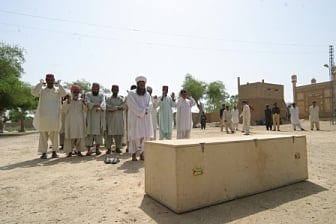
There was chaos on the streets. Rowdy young boys hurled stones at buildings, and grabbed money from burnt-out ATM machines. When one of them discovered that I was Punjabi, he snarled at me. Since the creation of Pakistan, the Baloch have accused the ruling Punjabi elite of usurping their social and economic rights. The young man asked me why their chieftain, who was perceived by the Baloch as being pro-Pakistan, had been killed. "If you can kill your own man, then what will you do to us?" he asked, his eyes defiant, and his young body quivering with anger. When he had been a young man, Nawab Bugti had been the first Baloch leader to vote for the creation of Pakistan. Thereafter, he was appointed governor and then chief minister. For many hardline Baloch nationalists, Nawab Akbar Bugti became a traitor when he took his oath under the federation of Pakistan. In Quetta, more than 10,000 mourners attended Nawab Bugti's funeral service. Those pro-government officials who dared to show up at the stadium where it was taking place were manhandled and thrown out of the glass doors by the angry crowd. Their blood covered the floor of the entrance to the stadium. After the funeral, enraged mobs took to the streets of Quetta, attacking public property. All government buildings that carried revenue records were torched by mobs shouting anti-military slogans. In their attempt to catch the world's attention, part of a UN building was also set ablaze by Baloch students. In the aftermath of the funeral, thousands of Baloch youth were arrested across the province, with the Baloch Students' Organisation (BSO) at the forefront of these protests. Years before Nawab Bugti was killed, the BSO had splintered off into several groups, and each of these groups had unofficially associated itself with various Baloch nationalist parties. Bugti's killing was a turning point for the BSO: it brought these groups under a single umbrella once more. The various group leaders also cut off their links to all nationalist parties, in an attempt to create a separate movement for independence.
One of the student leaders came to see me at my hotel, dodging several military check-posts on the way. The young man, who preferred not to be identified, said that the killing of Bugti had been the last straw in a long line of atrocities inflicted by the Pakistani state on the Baloch people. The Baloch now would not be content with provincial autonomy, he said. They wanted a separate homeland. "At first, we used to participate in political forums and debates," he told me. "We had affiliations with Baloch nationalist parties who preferred autonomy over independence. By killing the Nawab, who was seen by us as pro-Pakistan, the Pakistani government has demonstrated that it will only resort to violence when dealing with the Baloch. Thus, now we have no choice but to abandon political means and pick up the gun."