
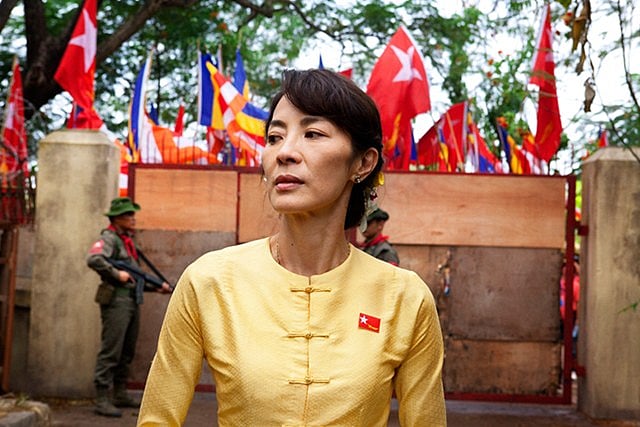
It all starts with a sizzle of excitement. A crowd draws near, and at its centre stands an elegant, frail woman. By the time she is on stage, however, she has become a powerful speaker, deftly deflecting questions, holding the expectant audience rapt. A thousand clichés are created, and a modern-day fairytale is born from the bosom of Hollywood. The result is director Luc Besson's The Lady.
That the film is, strictly, neither biopic nor political says a lot about the appeal of Aung San Suu Kyi, the film's protagonist. The Lady is primarily a tale of personal sacrifice – a quintessential ingredient in the creation of many a 'saint', from Buddha to Saint Francis of Assisi to Mohandas K Gandhi. The film stars the Malaysian actress (and former Bond girl) Michelle Yeoh, who spent time with Suu Kyi in the immediate aftermath of her release from house arrest in November 2010. At certain moments, Yeoh's preparation shines through, as she brings a few of Suu Kyi's mannerisms to the screen; but in truth, Yeoh never meets the challenge of depicting the Nobel laureate's humanity. Portraying the journey from housewife to living messiah is, perhaps, too great a task.
Suu Kyi is often compared to Gandhi, not least because she derives her political methods largely from the Independence hero. Their respective Hollywood eulogies also merit comparison. Richard Attenborough's Oscar-winning 1982 film Gandhi attempts to shape a political narrative from Gandhi's formational years through to his assassination. Not, however, without an opening proviso: 'No man's life can be encompassed in one telling. There is no way to give each year its allotted weight, to include each event, each person who helped to shape a lifetime.' Nonetheless, even that lauded film had historians and scholars scoffing at its oversimplifications; The Lady will have them doing more of the same.
Too early to tell
Given the circumstances of Suu Kyi's life, it is not surprising that the film is rather apolitical. The vast majority of the opposition leader's political career has been spent under house arrest – hardly the most cinematically compelling setting – amidst Burma's games of convoluted realpolitik. Further, Suu Kyi's political tale is also far from over, of course, as she is currently campaigning for election to Burma's Parliament. For better or worse, the political dimension of Suu Kyi's ascent is portrayed weakly at best, though it is a tantalising history.