
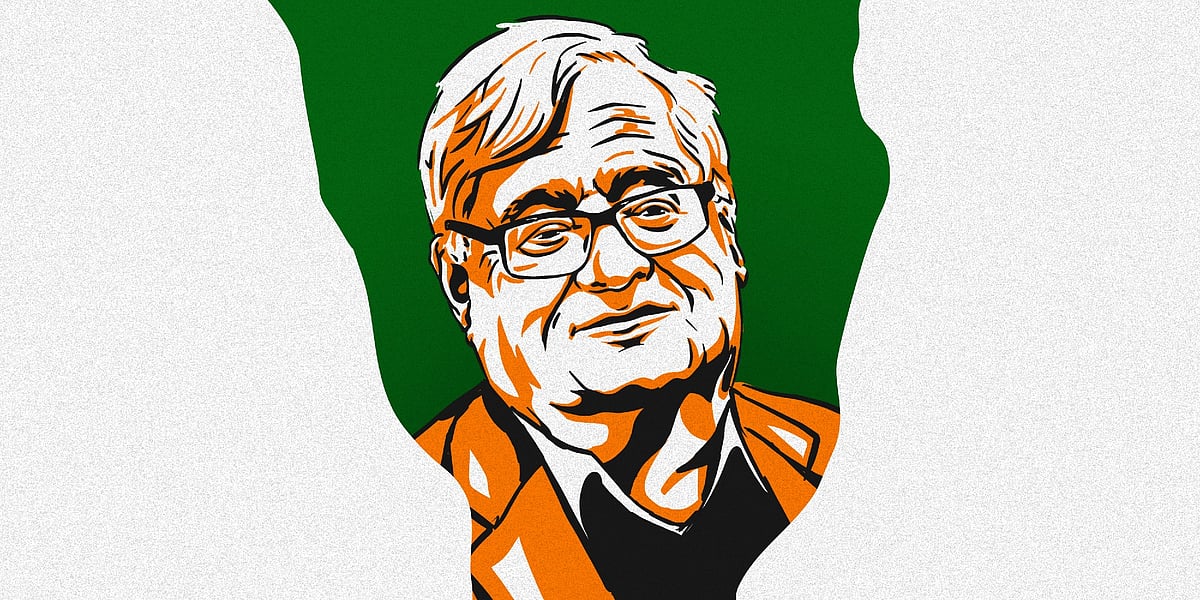
Modern Southasian history lost one of its stalwarts on 24 January 2021 with the passing of David Anthony Washbrook in Oxford, a few months before he reached the age of 73. I knew him for just under 36 years, about half his life, and our relationship constantly evolved and transformed over the decades. A number of rich tributes have already appeared from friends, colleagues and former students (including Joya Chatterji and Samita Sen in Cambridge), which have traced the broad lines of his career and his influence on several generations of scholars working on Indian history. Others will surely follow. My last exchanges with him before he was diagnosed with his terminal illness were, alas, on boring professional subjects such as referees' reports, and the academic politics of Oxbridge. In one of them, some months ago, he did slip in a more personal note: "We are all fine but looking forward to what is now promised as a steady 'unlockdown' in UK. Twelve weeks is a long time to be marooned even in Oxford! Let's try and meet up whenever we are allowed — preferably in Paris". That was surely a reference to a happy month some two decades or so ago that we had spent together in the City of Light, when he had been invited to the École des Hautes Études en Sciences Sociales (EHESS) in Paris and taken an apartment on Rue de la Convention. His presentation of four quite polemical talks on the current state of modern Indian history left his Parisian audience – unused to such verbal fireworks, delivered moreover at machine-gun velocity – a little bit bewildered. The American historian John Richards, also present on some of those occasions, for his part found them very amusing indeed. But he did remark in passing that he could think of no American historian of India who would present historiographical questions in quite such a manner.
By the time I first met him, on a cold February day at the old India Office Library on Blackfriars Road in London in 1985, David Washbrook was already a rather well-known figure among historians of India. I had read several essays by him in the course of my education in the University of Delhi, and had also dipped episodically into his more substantial works. His essays usually appeared on the reading lists of my teacher and doctoral advisor, the economic historian Dharma Kumar, though she was actually no great admirer of Washbrook (a sentiment that was broadly reciprocated). In her courses on the economic history of colonial India, we read the writings of not only Washbrook but several others of the same milieu and generation: Christopher Baker, Christopher Bayly, Neil Charlesworth, Clive Dewey, Peter Musgrave, Tom Tomlinson, and so on. We set aside those writings that were largely or exclusively focused on issues of politics, in favour of those with an economic content. Dharma's notion of a proper education, no doubt as unfashionable then as it is now, was that one not only read those whom one agreed with, but those with whom one profoundly disagreed. There was quite a long list of those who fell into the latter category, but the fact is we read them all so long as their arguments passed a minimal test of intelligence and literacy. It was only later, when I was visiting other Indian universities in the early 1990s, that I realised that not everyone was quite so generous about intellectual disagreements.
On that February day in 1985, my real intention was in fact not to meet Washbrook, but another of Dharma's friendly 'enemies', the American historian of south India, Burton Stein. Burt and Dharma had a pugilistic relationship, and she had written a few sharp critiques of his work but had also published him several times in the Indian Economic and Social History Review, which she edited. Given my dissertation topic, on the commercial economy of southern India in the 16th and 17th centuries, she felt it was absolutely necessary that I should make contact with him, because Stein was at that time one of a handful of authorities on the history of south India before 1700. Not long after I arrived in London, on a short archival visit, I telephoned him, and he immediately suggested we meet at the India Office. He added, however, that he would be accompanied by a friend, namely David Washbrook. I will confess that this was rather intimidating in theory, but less so in practice. Burt and David made a boisterous pair, one a working-class Jew from Chicago with a colourful vocabulary, the other a voluble Londoner of partly Irish descent. Over a couple of hours spent at a pub, they closely cross-examined me on my work, while simultaneously trading friendly insults between themselves. I found myself treated not as the raw student I was, but as a participant in a vigorous three-way argument. Some great names in Indian history were reduced to rubble before my very eyes. I learnt a new word of dismissal from Burt, the term 'cockamamie'. Over the course of the next month while I was in London, we repeated the experience a couple of times. By the time I left in March for Lisbon, David and Burt had assured me that if I wanted to send them a draft of my dissertation for comments, they would be more than happy to provide them.
I never took up David on this offer. But I did re-establish contact with him not long after in 1987, when he was visiting Harvard, and I was visiting the University of Pennsylvania to teach for a year after finishing my PhD in Delhi. It turned out that we had another friend in common, namely the specialist of the agrarian history of south India, David Ludden. The next year, 1988, I was in England, and Washbrook had returned by then to his home institution in Warwick. He invited me to his home for a weekend, which we spent mostly arguing over all manner of subjects. It was then, for the first time, that I heard David Washbrook define himself as a "classical Marxist". I will admit that this came as a surprise to me because in India, he was usually identified as part of the 'Cambridge school' of Indian history, which was considered to be a group of conservative apologists for the empire. In the simplistic representation that was usually laid out for students, historians of the colonial period were composed of two ideological camps: 'nationalists' and 'apologists'. The former included Congress-friendly historians, as well as the card-carrying members of the Left, while the latter was thought to include most British historians, as well as some Indians such as Dharma Kumar (who had been accused recently of denying the impact of colonialism by iconic Left figures like Irfan Habib). If one accepted the terms of this 'Manichaean' conception (the term is Dharma's), not only was it necessary to slot everyone into one or the other side, but all subtlety and nuance disappeared. How, for example, did one classify American historians such as Bernard Cohn, who had by then written a handful of ground-breaking essays? Were left-leaning Japanese historians such as Toru Matsui and Hiroshi Fukuzawa to be placed in the camp of the 'nationalists'? The potential hilarity resulting from this reductio ad absurdum was quite considerable. A further complication was that a number of even the self-avowed nationalists (such as the influential but astonishingly unproductive Barun De) had done their doctorates in Oxbridge and were inordinately proud of their degrees. Some, like Tapan Raychaudhuri, were apparently in such awe of the Oxbridge stamp that they did a second doctorate there, after having done a first one in Kolkata. One reads Raychaudhuri's autobiography with the sense of a man pathetically torn between opposing sentiments for the former coloniser: while constantly insisting on his sense of being disdained by Oxbridge, it was nevertheless there that he spent the twenty final years of his active professional career, teaching Southasian history at St Antony's College.