
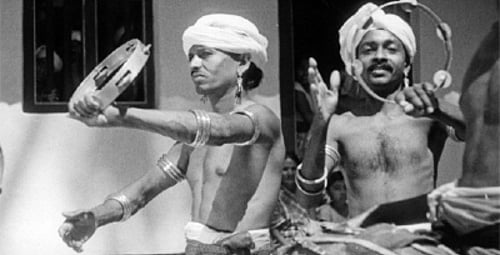
Sri Lanka has inspired some notable 20th-century artistic masterpieces, from D H Lawrence's poem "Elephant Is Slow To Mate" to Henri Cartier-Bresson's portfolio of photographs. Then there is Basil Wright's film Song of Ceylon, one of the finest documentaries ever produced. Made in 1934, it has been assessed by one Ceylonese critic as the film that has "best projected the image of the country, the soul of its people, and the endless beauty of the landscape with a subtle touch of magic for the world to see and admire." Indeed, over the decades, it has probably done more to publicise the island than any other promotional film.
Song of Ceylon was one of many outstanding documentaries produced in the 1930s by the Empire Marketing Board Film Unit (later the British GPO Film Unit) as the result of the pioneering vision of one man, John Grierson. In 1929, Grierson directed the influential film Drifters, which was the first example of what came to be called the British Documentary Movement. In the studio-bound British cinema of the time, a film like Drifters, which drew its drama from real life, was revolutionary. Grierson's simple story of the North Sea herring fishery brought what were then new and startling images to the screen.
Grierson was a brilliant theoretician as well as an accomplished filmmaker. It was he who first used the term documentary in relation to a film – in 1926, in a review of Robert Flaherty's film Moana. "Of course, Moana, being a visual account of events in the daily life of a Polynesian youth and his family, has documentary value," he wrote, later defining the word as "the creative treatment of actuality". And it was he who developed the documentary movement "to bring alive to the citizen the world in which his citizenship lay, and to bridge the gap between the citizen and his community." The "documentary idea", he wrote,
demands no more than that the affairs of our time be brought to the screen in any fashion which strikes the imagination and makes observation a little richer than it was. At one level, the vision may be journalistic; at another, it may rise to poetry and drama. At another level again, its aesthetic quality may lie in the mere lucidity of its exposition.