
Flowers of veneration,
At somebody's feet.
Placed by creepers,
Washed away by waves.
-Shambhunath Singh/em in emSamay ki shila par
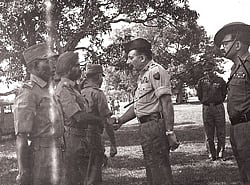
In the hoary Hindu tradition of eulogising the dead, the Indian Ministry of Information and Broadcasting recently declared that Field Marshal Sam Manekshaw was also an admiral. But even if inadvertently, the writer of the condolence message captured the essence of his personality. The field marshal has indeed been commander of the faithful all his life – the original meaning of admiral, before the term got appropriated by seafarers. There is an interesting anecdote about how the old warrior acquired his popular appellation. It is said that during a routine inspection, he introduced himself to a Gorkha soldier as Sam, and wanted to confirm whether the soldier had gotten his name correct. "Yes Sir, Sam Bahadur," the Gorkha replied. Bahadur, of course, was meant to be a mark of respect, which Sam understood and wore like a badge of honour.
In colloquial Hindostani, bahadur is often used as synonym for a watchman or chowkidar. Even in formal usage, the word is loosely translated as 'brave'. A bahadur is invariably bold, courageous, fearless and valorous – bravery personified. But it does not stop there. If courage is grace under pressure, bahaduri lies in taunting adversity, looking danger straight into the eyes, making fun of setbacks and attempting to snatch victory from the jaws of defeat. However, there is no shame in accepting unpleasant outcomes. Bad losers grouse about defeat; samurais commit ritual suicide. A bahadur moves on and lives to fight another day.
Bahadur is a complex concept, and the British Indian Army did not have a word for it. So, they simply appropriated the term, and began to use it rather indiscriminately. That may be the reason their successors in the Indian establishment could never understand Field Marshal Manekshaw's fascination with the term. Bahadur, as he was in the truest sense of the term, would have undoubtedly been bemused by the hullabaloo that has arisen after he was gone. He would have probably taken the controversy over such arcane matters as warrant of precedence, propriety of the presence or absence of service chiefs, defence minister, prime minister or president with a shrug, a broad smile and a laconic comment: "Corpses do not complain." The Indian state did seem ungrateful to the man who led the only war it had won hands down. But the fact is that Sam Bahadur had never been a favourite of the Indian establishment. He was a soldiers' general, and his men will continue to remember him with a mixture of admiration and fondness.