
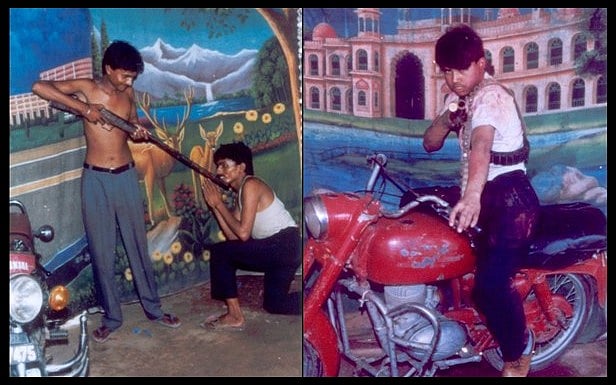
Satish Sharma is an Indian photographer, curator and cultural critic whose work focuses on urban life in India. Kabita Parajuli, with the Hri Institute for Southasian Research and Exchange in Kathmandu, spoke recently with him about his view on photography and representation.
How did you start working in this field?
I was coming across art spelled with a capital 'F' as in 'Fine Art'. So I switched from that to journalism. I saw photography mostly from the perspective of text, not as an image which is purely about itself and about art. That was the first real take-home point: that photography is about text, writing with light. Now I write – but I write about photography. Because all these experiences have come together I can understand the cultural politics of photography, and the cultural space it inhabits. This is much more important for me than just what is in the frame.
When you first started writing publicly, there was a lot of very strong reaction to what you were saying.
My argument was that knowing the history of photography's aesthetic growth is not the same as knowing photography as a medium. And what Raghubir Singh and most photographers ignored when they talked about the history of photography is the colonial use of photography. Too many photographers were and are just continuing the white, male colonial gaze, in the so-called documentary tradition. It is still the upper class looking down at the lower classes, fixing certain identities, and fixing socio-political spaces. That's when the questions about documentary emerged. They upset the status quo because they were uncomfortable questions.
What did your critics say?
'He's just an intellectual' – this was a dismissive term. 'He's a frustrated photographer.' I used to go through these phases; I kept shooting, but I didn't publish, or I didn't show. I was writing. Which meant people would say, 'Oh, he's a former photographer.' But it was all trying to fix me in one identity, as a photographer and nothing else. I had one well-known photographer turning around and asking, 'Who's given him permission to write?' Like you need permission to write. It was alright if I wrote for his exhibition, but I couldn't write anything critical. He asked me to write for this exhibition he was having, and so I began with this line that photography is a cultural construct. And he got very upset because he has a habit of constructing his pictures, arranging them. And so he said – 'I want you to get rid of that…word.'