
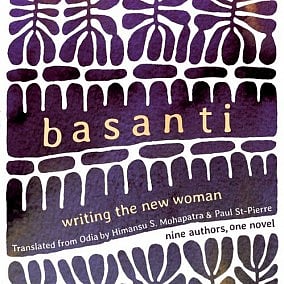
Fuelled by the nationalist movement in India, collaboration and team work emerged as the new zeitgeist of literature in the 1920s. The charged climate of the decade made writers conscious of the political nature of art. As writers explored ways – often jointly – in which given cultural thresholds could be crossed, several existing ideas about literary production were questioned, chief among which was the idea of individual ownership of a literary work. An experimental enterprise of 'collaborative writing' caught the fancy of young writers from both Bengal and Odisha around this point of time in history. The period witnessed a string of collaborative novels like Baroyari (12 authors), Bhager Puja (16 authors) and Chatuskona (4 authors), which initiated a new artistic practice of collective imagining in Bangla literature. However, Odia writers of the time carried the experiment of collaborative writing further. In Basanti (1931), written by nine young Odia authors, two progressive currents, of collective composition and an agenda of reform, were made operative within a single narrative.
Literary experimentation in the 1920s was bound up with serial publication in journals. Journals such as Utkala Dipika (1866) and Utkala Sahitya (1897) provided a platform for Odia writers and were instrumental in bringing about a "Renaissance of Odia letters", as is stated in the introduction to the English translation of Basanti. It was in Utkala Sahitya that Fakir Mohan Senapati's masterpiece of social realism and satire Chha Mana Atha Guntha (Six Acres and a Third) was serialised from 1897 to 1899, before being published as a book in 1902. The same goes for the proto-feminist Basanti, which was first serialised in monthly installments in Utkala Sahitya between May 1924 and November 1926.
For modern readers, however, Basanti's publication history can appear to be both interesting and baffling. Published in book form in 1931, Basanti sank into oblivion and was resurrected almost 40 years later in 1968. But then it went out of print again and continued to remain in that state to date. Now, over 50 years since its most recent publication and over 90 years since the original serial ended, it has returned again but in a new form and in a new language. Basanti's publication history invariably brings to mind G V Desani's 1948 novel All About H. Hatterr, which had a similarly checkered career. Now considered to be an important precursor of postcolonial writing, for its comic bending of grammatical rules and pushing the frontiers of the English language, Hatterr too went underground immediately after publication and resurfaced 21 years later in 1969, with an introduction by Anthony Burgess. The book, although available now, remains a kind of coterie classic in Indian literary circles.
Basanti was not written for a coterie audience; social reform was at the heart of this collaborative novel. It scores on two unprecedented fronts in Odia fiction. Firstly, it was the product of a collective attempt of nine authors, six men and three women: Baishnab Charan Das, Prativa Devi, Sarala Devi, Suprava Devi, Muralidhar Mahanti, Harihar Mahapatra, Sarat Chandra Mukherjee, Kalindi Charan Panigrahi and Annada Shankar Ray. These young authors belonged to the 'Sabuja age' (literally the Greens, but harking back to Romanticism), who dared to break away from the popular trend of garrulous and sentimental narrators in Odia fiction to a literary practice of depicting strong, ideologically driven, modern characters. This shift in the source of narrative momentum enabled the collaborators to enter into a serious narrative inquiry of the 'woman question' and debates over the formal status of women and their roles in a society divided along caste and gender lines.