
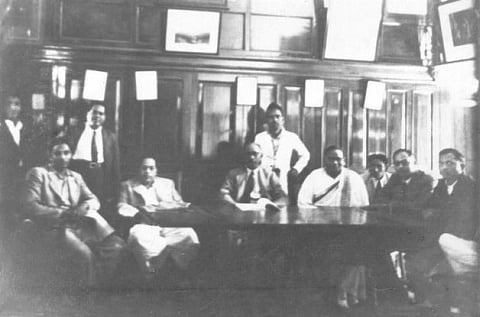
Jogendranath Mandal was born on 29 January 1904, in a predominantly Namasudra (an 'untouchable' caste, formerly called 'chandala') village called Maisterkandi of northern Barisal District, in a Bengal on the verge of being partitioned by George Nathaniel Curzon's pen. Though his parents, Ramdayal and Sandhyadebi, doted over him as the youngest of their six children, they often struggled, and at times failed, to provide him with an education at nearby village schools. Over the next few decades, he would rise from these humble origins to become one of the most vocal and articulate leaders from amongst the Scheduled Caste communities of British India.
Despite (or perhaps because of) his trenchant critique of the social relations of caste inequality in Bengal, he is today hardly remembered, much less understood by the people and country into which he was born. In a state that has long proclaimed its exceptionality in terms of the casteism seen elsewhere in India, Mandal's marginality in historical narratives seems eerily and curiously fitting. Recovering and listening to his past, then, is to encounter social forces deemed anachronistic in an allegedly secular, communist state. Mandal's most significant contribution was his struggle for a freedom that embraced the ideals of social equality and democracy – a struggle directed squarely against the ideologies and practices of both casteism and communalism.
Mandal's childhood coincided with the Swadeshi movement in Bengal, an initiative driven predominantly by upper-caste Hindus that sought to galvanise the Muslim and lower-caste-Hindu peasantry against the British-led partition of the province. This attempt to enlist the support of these communities for a cause to which they were at best indifferent, if not downright inimical, dramatically failed. It was in these early years of Mandal's life, through conversations with his uncles and some of his own embittering experiences, that he would learn of caste discrimination. He therefore grew up unusually sensitised to the everyday slights of caste society. Cobbling together whatever financial means possible, his family sent him to a number of proximate village schools. In a waterlogged Barisal, this meant rowing through marshlands and wading through inundated fields, returning home to attend to the domestic duties required of any child of an agriculturalist family, and studying by the light of a lantern. It was thus with considerable difficulty that Mandal received a primary and secondary education.
In 1924, with financial assistance from his extended family, he was able to join the Barisal Brajamohun College to pursue studies in Indian administration. While at college, he became involved with the nationalist leader Aswini Kumar Datta's organisation Little Brothers of the Poor, a social-welfare association primarily concerned with the alleviation of poverty and health-related issues amongst the peasantry. In 1926, he would organise a campaign of protest against the treatment meted out to a fellow Namasudra student by caste Hindus for daring to enter a local temple. The same year, he would address a meeting in Agailjhara village, beginning to hone his oratory for which he would later be renowned, stressing the need for lower-caste unity. Clearly, as early as his 20s, Mandal exhibited significant concern for transforming the conditions of life endured by lower-caste communities. He graduated the same year and, several years later, in 1929, earned admission to the Calcutta Law College.