
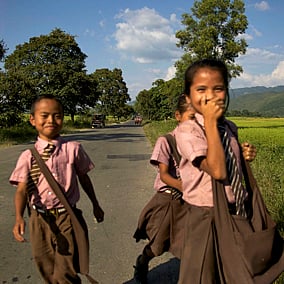
The road in Yirmiyan Arthur Yhome's documentary, This Road I know, carries the weight of many metaphors. At the beginning of the film, it takes us into the memories of the director's idyllic childhood. As the narrative unfolds, it turns into a device to explore ethnic divisions and the history of violence that marks the region where Yhome grew up.
The road in question is the highway between Nagaland and Manipur. As the filmmaker notes, it is a symbolic, as well as an economic, lifeline to the rest of the country. Blockades are often enforced on this road, causing terrific damage to local economies and hardships to residents – a note that is sure to have resonated with the audience in Kathmandu during Film Southasia 2015. The capital is reeling from shortages due to the blockage of fuel and other goods on its border with India, now in its second month.
The film traverses geography and history through the lens of Yhome's personal journey across the terrain of these states. The first glimpse of Kohima of her childhood, for instance, is of a city of light, accompanied by singing of her siblings as they made their way home. Her coming of age coincided with state excesses, insurgency and ethnic divides between Nagas and Kukis. With time, she says, came an awareness of the army presence along the highway. And with adulthood came the scrutiny at the checkpoints on the road, that made residents feel like they were "living in a zoo", in the words of one student activist. In one sequence that appears to have been shot surreptitiously, Yhome, who has lived in Delhi for many years, speaks in passable Hindi to a soldier at a checkpoint as he searches her car. This can't be easy for you either, she tells him. And he agrees.
On this road, she recalls, she had a gun held to her head, once by the security forces and once by an "underground" or insurgent. Along with the conflict, her film documents the voices that rose against the killings. Yhome channels stories of incredible courage along the road. Like K Matia, who returned to her village on the border between Nagaland and Manipur to attempt to do what she could to stop the violence. From her roadside stall, she recalled getting into buses and urging people to get down and buy what they needed without being scared, as there were "mothers" there to protect them. A far cry from Yhome's childhood, when the road was dotted with abundance, from pineapples to bamboo shoots, to dried mushrooms, especially picked up from Kuki towns.