Elephant Pass is the narrow strip of land connecting the island landmass of Sri Lanka to its northern Jaffna Peninsula. Bordered on left and right by lagoons and marshes, this isthmus carries both the main A9 Highway and the railway line connecting Jaffna to the rest of the country. In the nearly 30-year civil war between the LTTE and state security forces, the Jaffna Peninsula was of keen strategic importance for both sides, and control over this vital link has been fought over on at least two modern occasions. During the course of its struggle to establish a Tamil homeland in the north and east, the LTTE first attempted to capture the Elephant Pass military camp in 1991, but was thwarted. Its second attempt, however, in April 2000, was brutally successful, and was considered the biggest debacle suffered by the Sri Lankan forces at the time. The LTTE proceeded to hold the territory until the final phase of the war, when the Sri Lankan forces recaptured rebel areas and eventually eliminated its top leadership, including its leader, Velupillai Prabhakaran.
Sri Lankan feature films based around the civil war have been few and far between since the conflict began in the early 1980s. In 2001, the human-rights activist Sunila Abeysekera noted that it was "quite remarkable" that contemporary Sri Lankan cinema had "failed to deal with critical moments in the history of the island that have led to sometimes violent social and political upheaval". For Abeysekera, the "most critical silence and absence" was "that relating to the ethnic conflict and the subsequent state of civil war in the country". Despite Sri Lanka's claims to being a multi-ethnic and multi-religious country, its cinema, says Abeysekera, is exclusively in Sinhala and "represents and reproduces the lives and concerns of the majority Sinhala-speaking people of the island. In the context of a history of discrimination and marginalization of minority communities … this absence could also be considered as part of the same process of erasure."
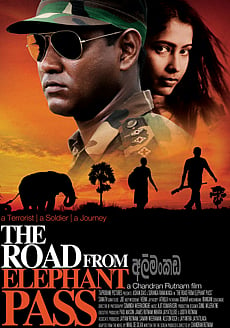
What Abeysekera said ten years ago remains relevant today. To date, only about a dozen films have been made on the subject of the civil war; and, it could be argued, out of these only five have attempted to deal with the conflict in any meaningful way, with a creative use of the language of cinema. Among those that have attempted to do so can be counted Prasanna Vithanage's Death On A Full Moon Day (1997) and August Sun (2003), Asoka Handagama's This Is My Moon (2000), Sudath Mahadivulwewa's Shades Of Ash (2003) and Vimukthi Jayasundara's The Forsaken Land (2005). These five films are set in the Sinhalese-majority milieu, and in the main the conflict is seen from the perspective of the ordinary Sinhalese people – especially villagers eking out an existence on the borders of the battle zones in which their sons and daughters are combatants, not so much due to their patriotism but rather because the army pays a better wage than what they would earn working the land. These films are deeply analytical and troubling. The negative way the war has impacted on all aspects of the lives of the Sinhalese polity is examined in stark detail, with a keen sense of the possibilities of the cinematic language, seen in its various usages in Vithanage's minimalism, Handagama's experiments with form, and Mahadivulwewa's and Jayasundera's stylisations. Unfortunately, the latest addition to the genre, The Road from Elephant Pass, does not fall into this rare company.