
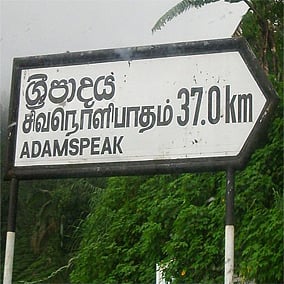
If one were to visit the office of the Official Languages Commission (OLC) in Colombo, one would see officials busily filling out correspondence to be sent to several government departments. Set up in 1991, the functions of the Commission, mandated by Section 18 of the Official Languages Commission Act, are to monitor "regulations, directives or administrative practices" which violate existing language regulations. The Commission also conducts educational programmes on language development and language use, and one of its main tasks is ensuring that Sinhala and Tamil are given equal prominence in public administration.
Sri Lanka's current constitution lists Sinhala and Tamil as official languages, with English being given the status of a 'link language'. The wording of the constitution, however, is problematic. Chapter 4, Sections 18 (1) and (2) of the Constitution proclaims:
This suggests that Tamil was added as an afterthought, or a later addition – which, in fact, it was. After achieving independence in 1948 both Sinhala and Tamil were official languages until a 'Sinhala Only' Act came about in 1956, taking away the official language status of Tamil. The Act was partly reversed in August 1958, with the Tamil Language (Special Provisions) Act allowing for education, admission for public service, administrative functions and state correspondence to be conducted in Tamil in the North and East provinces. The 1978 constitution made Sinhala and Tamil national languages but maintained Sinhala as an official language, with the current iteration being added in 1987 through the Thirteenth Amendment. The amendment was partly fueled by international pressure, particularly from India. The signing of the Indo-Sri Lanka Peace Accord reinstated Tamil as the official language, among other concessions on devolution of power to the provinces. India also agreed to end its support for the Tamil separatists.
Language, as one of the flashpoints of ethnic conflicts, has long been cited by many studies as one of the main factors that led to Sri Lanka's civil war. During colonial times, Sinhala nationalists felt Tamils received a disproportionate share of civil administration posts. When the country finally gained Independence in 1948, the Sinhalese hoped to be awarded a greater share of such opportunities, in keeping with their standing as the majority community. When this did not transpire, resentment against the Tamils grew. Although the situation had been precipitated by colonialists, the Sinhalese felt frustrated that their Tamil counterparts were able to access services that they could not (since the Sinhalese were not as conversant in English). For instance, banking transactions not conducted in English were considered illegal until 1953. Even Parliamentary debates were conducted in English; permission had to be secured to use either Sinhala or Tamil.