
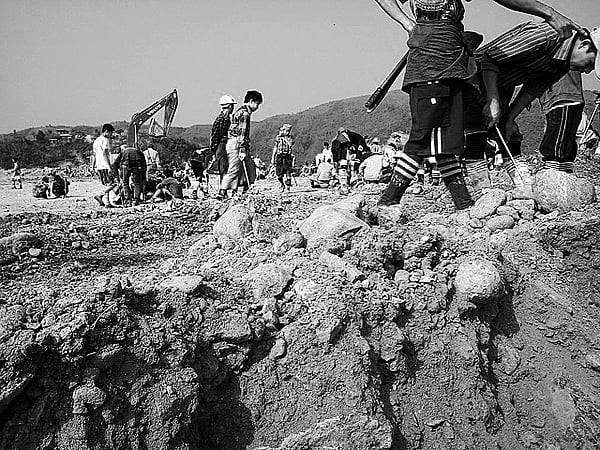
One minute you are crouching on a steep slope, examining a round stone clutched in the palm of your hand. Then a rumbling deluge of mud, boulders, gravel. Crushing you and everything you came here for, the illusion of jade treasure, the struggle for bare survival. And you have disappeared.
The ongoing catastrophe in the Hpakant jade-mining region of Kachin State in northern Myanmar produces a grim roll call. 21 November 2015: more than 200 workers buried in their campsite. 25 December 2015: "waste mound" kills 50. 6 January 2016: 20 killed. 25 January 2016: 100 killed. 4 April 2018: 6 killed in landslide. 4 May 2018: at least 17 dead. 14 July, 2018: at least 15 confirmed dead, survivors believe over 100 buried. 24 July 2018: 27 "feared dead." 12 February 2019: 6 killed in "cliff collapse."
The conditions at Hpakant received some international attention after a 'mud lake' of liquified tailings (mining waste) buried at least 54 employees of three jade mining companies, on the night of 22 April 2019. Geographer Dave Petley of the University of Sheffield estimated nearly 1000 to have been killed in such Hpakant incidents from January 2015 through April 2019. Most recently, in the early hours of 28 July 2019, at least 15 workers, including employees of Yarzatarni mining company and security guards, were killed when a hillside suddenly collapsed on top of tents where they slept. All are casualties of Myanmar's economic focus on resource extraction, routinely conducted without protection for workers or the environment. They are victims of the lure of jadeite – precious jade.
Jadeite, found in commercial quantities mainly in Myanmar's Kachin State, is a hard, crystalline stone formed by subduction zone pressure. Traded mainly to neighboring China since 1784, jadeite became known as 'imperial jade' when it replaced nephrite, a more widespread mineral also known as jade, as an object of obsession among Chinese emperors. The hues of jadeite include famously vivid greens as well as white, lavender, blue and black. Depleted from the Uru River, a Chindwin River tributary, jadeite is now open-pit mined in the hilly terrain of Hpakant Township for dull-surfaced boulders, which may reveal brilliant interiors when sliced.