
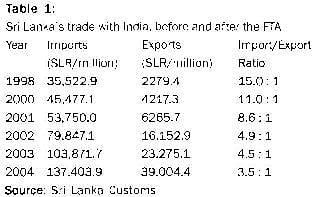
In contrast to the sometimes difficult political relations between India and Sri Lanka, economic ties between the two have expanded impressively in recent years. Despite a number of problems, the Indo-Lanka free trade agreement, which came into effect in 2000, has become a model of economic cooperation – one that has benefited the smaller partner relatively more than the larger one.
India's political relations with its southern neighbour have had their share of difficulties. Colombo has occasionally accused New Delhi of turning a blind eye to the overt and covert material and moral support given to the LTTE by supporters of their separatist militancy in Tamil Nadu. Indian fishermen have been frequently arrested for fishing in Sri Lankan waters. There are also outstanding issues relating to the settlement of Sri Lankan refugees in Tamil Nadu, and the granting of citizenship to Tamil-speaking people of Indian origin in Sri Lanka.
On the economic front, however, Indo-Lankan relations have increasingly been on an even keel. The bilateral trade and investment links have deepened and widened considerably over the last seven years, despite areas of contention and dispute. The signing of the bilateral free trade agreement (FTA) marked a turning point in economic relations between the two countries. The FTA is considered to be a shining example of economic cooperation in Asia: while it has helped both countries expand trade, as suggested above, Sri Lanka has gained disproportionately. This is arguably the most noteworthy aspect of the FTA, although there have been surges in the import and export of certain items that have disrupted industries – and jobs – in both countries.
For the first time in a decade, Sri Lanka's exports to India dropped in 2006 – from SLR 56.2 billion in 2005 to SLR 50.9 billion in 2006 – primarily due to problems with exports three commodities that can be imported duty-free under the FTA: copper, pepper and vanaspati, a cooking medium made from vegetable oil. India's exports to Sri Lanka, on the other hand, went from SLR 145.6 billion to SLR 187.6 billion during this period.