
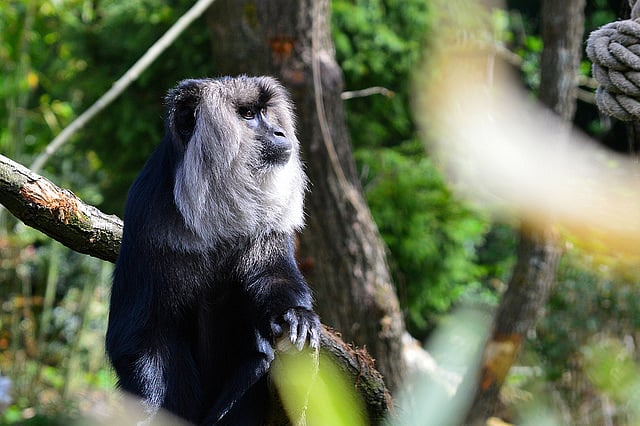
Once a month I would go up past the tea estate and follow lion-tailed macaques for three days. This would also be from dawn to dusk. Since these animals had a huge home range, of about 600 hectares for a group, they were not easy to find. A team of trackers was employed to locate them. Every month they would start looking for the study group. Sometimes they would find it within a day. Sometimes it would take up to three weeks. After finding the group, a message would be sent to me, and I would then drive up.
I would stay at the electricity board guest house at Upper Kodayar. This was a new hydroelectric project that had just been completed, and the construction had left the area and its surrounding forest looking as if bombs had been dropped there. Since my predecessors had opposed new dams coming up in the area—and three more had been planned—I was an object of suspicion to the engineers who often stayed there. They were friendly enough. But why would anybody want to stop progress for the sake of a monkey? I was asked constantly by both the local engineers as well as the police (usually after attempts to get me drunk were made), whether I was an American spy.
The lion-tailed macaque, over the next few years, became an object of hatred among the various planners in Tamil Nadu and Kerala. In Tamil Nadu, at least, there were alert and interested persons at senior positions in the forest department who were determined not to allow the upcoming dam projects. They were killed at the bureaucratic level. However, in Kerala the whole controversy about whether to construct a dam in Silent Valley revolved around the lion-tailed macaque.
As an aside, what was astounding about the Silent Valley controversy was that those who opposed it got away with it. Most claims made by the environmental brigade were easily falsifiable. A perusal of the guest house visitors' book at the entrance to Silent Valley suggested to me that about 80 per cent of the people who had written indignant articles objecting to the dam had never even visited the place. Luckily the electricity board didn't have any competent ecologists on its side. Now of course the case against the dam should be unbeatable, political compulsions notwithstanding, since we know so much more. This is not to say that the dam should have been built, just that the 'scientific' case against it was very shaky indeed.