
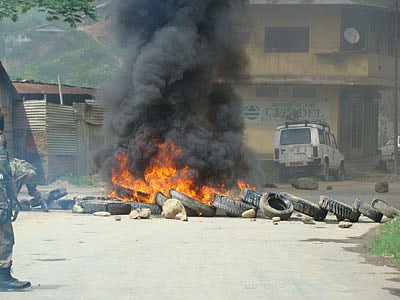
For those who witnessed the events of 18 June 2001 in Imphal, the images are unforgettable. That morning the entire city was aflame, accompanied by the smell of burning rubber tyres. Trees were downed on the roads to bring traffic – and life – to a standstill. Thousands of people also took to the streets on that day, as Imphal descended into chaos. The state Legislative Assembly was burnt down, as the people protested the decision of the New Delhi government to extend the ceasefire with the armed Naga group, the National Socialist Council of Nagalim (Isak-Muivah), in some Naga-inhabited parts of Manipur. One of the outfit's longstanding demands has been (and remains) the creation of a pan-Naga homeland, and the extension of the ceasefire was seen as the first step in that direction. One of the enduring images from that day is a girl in a phanek and dupatta stopping a military jeep and banging her head against its bonnet. She was neither an activist nor a volunteer of any student group. She was just a lay person who walked out from nowhere to express distress at what she perceived as a threat to the territorial integrity of Manipur.
What followed is history. In July 2001, the continuing opposition to the move forced the central government to restrict the ceasefire with the NSCN (I-M) to Nagaland and not extend it to other Northeastern states, but not before 18 protesters died by police bullets on 18 June, engaged in what the demonstrators felt was a struggle to save Manipur's territory. The irony is that these young men and women had little sense of belonging to the territory they were protecting, but were still ready to give up their lives for it. Territory is marked only by thin lines, and in Manipur even those lines are often little more than a blur.
The issue of Nagalim, or Greater Nagaland, has once again come to haunt Manipur, driving a wedge between the hills and the Imphal Valley below. On 11 April, the United Naga Council (UNC) and All Naga Students Association of Manipur (ANSAM) imposed a blockade on National Highways 39 and 53, the only two arteries into Manipur. Their demand: greater autonomous powers to the district councils in the hills of Manipur, where they reside. As a corollary, they also resisted elections to the district councils (slated to begin in late May) before amendments were made to the legislation that governs the councils, the Manipur (Hill Areas) District Council Act of 1971. The situation become still more confused a few days later, when the Naga Students Federation (NSF), which controls ANSAM, extended the blockade on the Nagaland stretch of the highway in protest against the Manipur government's refusal to allow its members to enter the state to hold an annual assembly (for an overview of these events, see box).
Manipur is a bowl-like valley, and it is on the valley floor that about 56 percent of the population lives – the majority ethnic Meitei, largely Hindu. The other 44 percent, largely composed of tribes such as the Naga (around 22 percent), Kuki, Kabui and Paite, all of whom largely follow Christianity, occupy the surrounding hills, which in fact constitute almost 90 percent of the territory. The grievance has long been that the Imphal Valley controls the political power and financial authority, and has historically neglected the hills. The people of the valley, while admitting to this neglect, also claim that the hills have been hostile towards the state, and have thus distanced themselves from development. Also, the valley people cannot purchase land in the hills, but hill people can buy land in the valley – given this additional protection, the people of the valley feel that those in the hills have no grounds to feel resentful. But distrust has been building over the decades.