
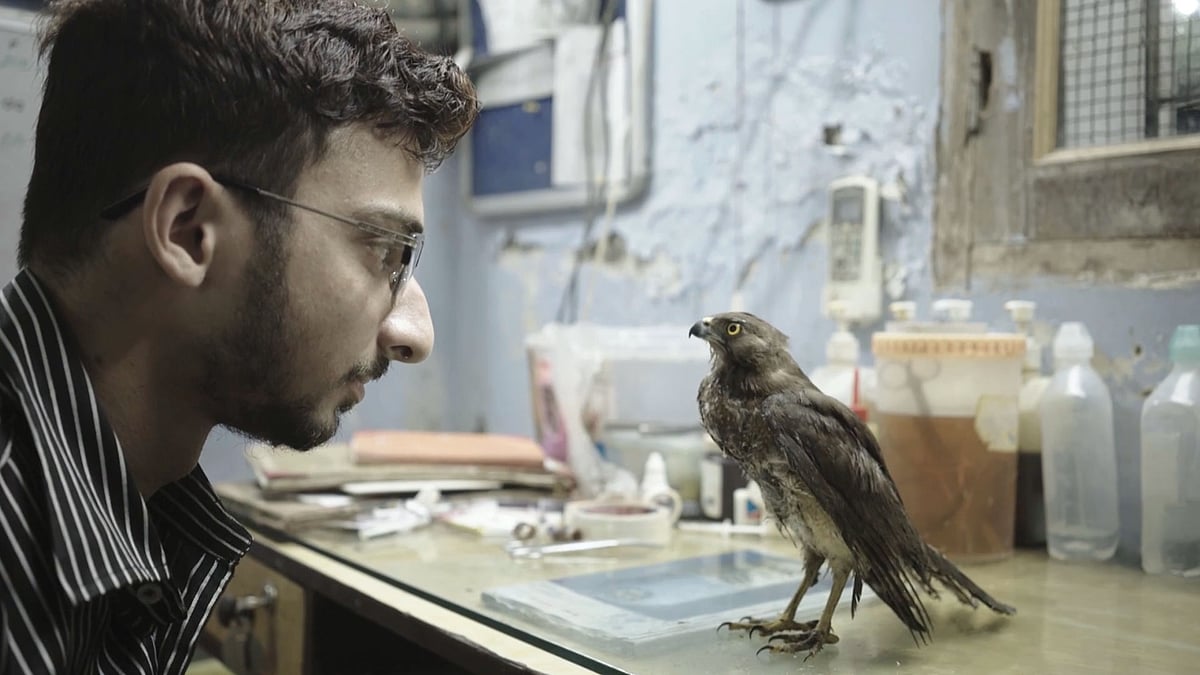
In a scene that forms a connecting tissue between various themes in the documentary All That Breathes, two brothers stand praying beside their mother's grave in Delhi. Nadeem Shehzad and Mohammad Saud have spent over two decades treating injured and unwell birds – specifically, kites – in the city. As they leave the cemetery, they reminisce about their Ammi's religious fables and tales of djinns, which gave them their earliest understanding of science and animals. She spoke of spirits that appear in the form of serpents and insects, one of them recalls. "One shouldn't differentiate between all that breathes," he says. "Trees, fungus, or vegetation, natural and supernatural worlds were mixed for her."
The interconnectedness of living beings is the thread running through the Indian director Shaunak Sen's documentary feature, nominated for an Oscar at the Academy Awards in Hollywood this weekend. The film focuses as much on human beings as on birds, though the way it has been framed leaves it wide open to interpretation.
Kites are not an endangered species. We learn from the documentary that the siblings' interest in caring for them in particular began when a bird they took to an animal hospital as teenagers was turned away "because the kite is non-vegetarian". According to earlier news reports about Nadeem and Saud's work, the hospital was run by the Jain community, whose commitment to ahimsa, or non-violence, extends to a strict adherence to vegetarianism. The establishment did not treat carnivores, since feeding meat to patients was not allowed. For those unfamiliar with India, the matter might end there, even if the idea of leaving creatures to die in the name of non-violence is bewildering. But for those aware that the country's marginalised communities, particularly Dalits and Muslims, are vilified for their meat-inclusive diets, this incident is far from innocuous. Hindu majoritarian militants have tried to justify multiple lynchings in recent years by alleging that the victims, invariably from marginalised groups, were stocking beef or somehow involved in the butchering of cows, considered sacred in Hinduism. The docu-feature does not spell out this bigger picture, instead leaving it to viewers to join the dots.
All That Breathes does not register Nadeem and Saud's reaction to the rejection at the hospital, but a 2020 New York Times profile noted that they were confused by what they saw as, in Nadeem's words, "discrimination between a vegetarian and a nonvegetarian". The article quotes him saying: "It hit us somewhere inside, because we were nonvegetarian ourselves."