
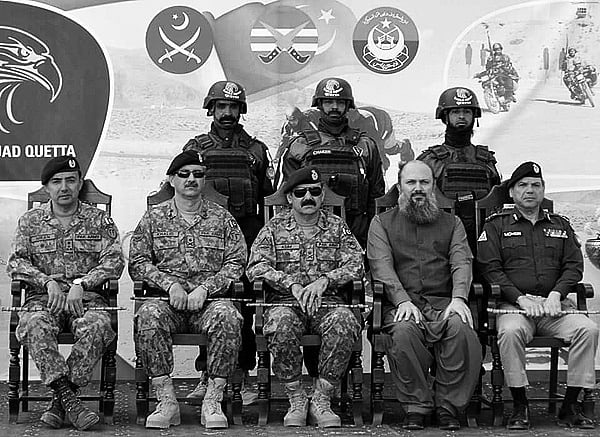
At the World Economic Forum in Davos in January 2019, when Balochistan's Chief Minister Jam Kamal Khan declared that Balochistan was open for business, he was following in a long tradition of politicians hoping to attract capital to the resource-rich yet economically struggling province of Pakistan. Interestingly, in making this pitch to the gathering of the world's business elites, Khan was accompanied by General Asim Saleem Bajwa, former head of the Pakistan Army's media wing, who currently leads the Southern Command in the Baloch capital of Quetta.
The Davos appearance was the latest among a series of events that marked the political ascendance of Chief Minister Khan, or more accurately, of the Balochistan Awami Party (BAP) which he hails from. Formed amid political turmoil less than a year ago, the BAP is in many ways a new phenomenon in Balochistan. It takes a hitherto untraversed route in the province's politics – it is neither a regional extension of the national parties nor ideologically committed to Baloch nationalism or Islamist politics. The BAP is the first Balochistan-based federalist party.
While some of its political demands – the province's control over its own resources, for instance – are similar to that of Baloch nationalist parties, it avoids their nationalist rhetoric and couches its agenda in the idiom of development – on the need for economic uplift of Balochistan by improving governance and attracting foreign investment. The cofounder of the BAP, Saeed Ahmed Hashmi, frankly affirms that the party was formed to bring together Baloch leaders opposed to ethnic politics. Notably, the BAP leaders routinely excoriate the nationalist parties for Balochistan's privations but absolve the military of any wrongdoing in the province, ignoring questions of enforced disappearances, torture and murder of political activists in the region. Over the past year, the party has significantly weakened the hold of regional and national parties that have traditionally been in power in the province.
Opaque origins