
Inside the first floor of the National Archives in Delhi, the tube-light was buzzing. It was a noise I had grown accustomed to, along with the soft rustle of pages being turned, in an otherwise quiet catalogue room. Under its grey-blue hue, I accidentally stumbled across an entry in one of the catalogues. It listed a file from 1944 documenting some of the earliest obscenity legislation enacted against Saadat Hasan Manto (1912-1955), one of the most controversial Urdu writers of the twentieth century. I quickly jotted down the notation and submitted my request to the archival staff. I had so far been feeling dejected in the archives. Many of the files I had requested were missing or non-existent. But luckily, not this time. My request was answered with a bundle of documents: a small but telling sample of the colonial state's widespread censorship of Indian publications during the Independence movement.
This was not the first nor last time that Manto would be brought to trial on obscenity charges. His short stories were banned six times: thrice before Partition in colonial India ('Dhuan', 'Bu', and 'Kali Shalwar'), and thrice afterwards ('Khol Do', 'Thanda Gosht', and 'Ooper Neeche Darmiyan') in Pakistan. Today, Manto's writings – which remain seminal for understanding Partition – are more available to English audiences than ever before. Like others of his generation, Manto wrote powerful responses to the carnage of 1947. But Manto's literature had long focused upon themes of violence and sexuality in the more quotidian sense. These stories were often set in Bombay, where Manto lived as a struggling writer, traversing film studios and footpaths. In them, readers see the world through the eyes of prostitutes, pimps, gamblers, dadas and rickshaw drivers negotiating the jagged, painful spaces between ghar and ghat. It was through his often frank treatment of sex and sexuality that Manto boldly criticised social hypocrisy. Accusations of obscenity were often hurled his way. In the case of his short story, 'Bu' (Odour), those accusations were also hurled in the courts.
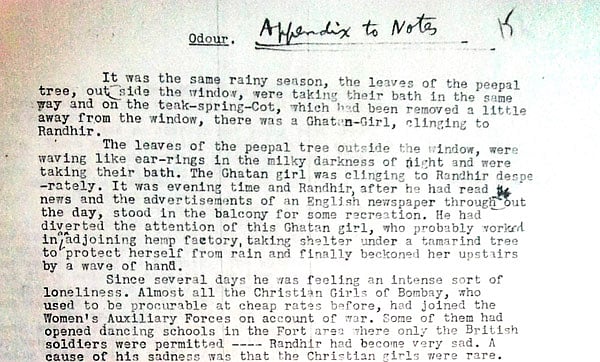
The late colonial-era file on Manto's trial for 'Bu' is several pages long. In between the bureaucratic correspondences and transcripts of Manto's trial, the file also contains the very first English translation of 'Bu'. The type-written translation is littered with grammar corrections, on the text as well as in the margins – in red ink no less. The translator's name is nowhere to be found. As my eyes gazed over the documents I realised that I had wandered on to a crime scene. There lay the translated short story, flat and dead. It had been beaten violently by the coloniser's language. As I turned the pages, parts of the translation would reappear in memos and notes as state officials came to pick apart the dead body, exhume it, probe it and use it as evidence in the courts.
I also realised I had to re-read 'Bu'. The first time I read it, I had found the story deeply troubling and it had made me uncomfortable. But that is what it is supposed to do, I hear the literary critics say in my head. Manto's writing has a stinging quality, lacerating the reader with dark irony, with prose and diction that is abrasive and bears into you like a twisted knife – this is the hallmark of his genius.