
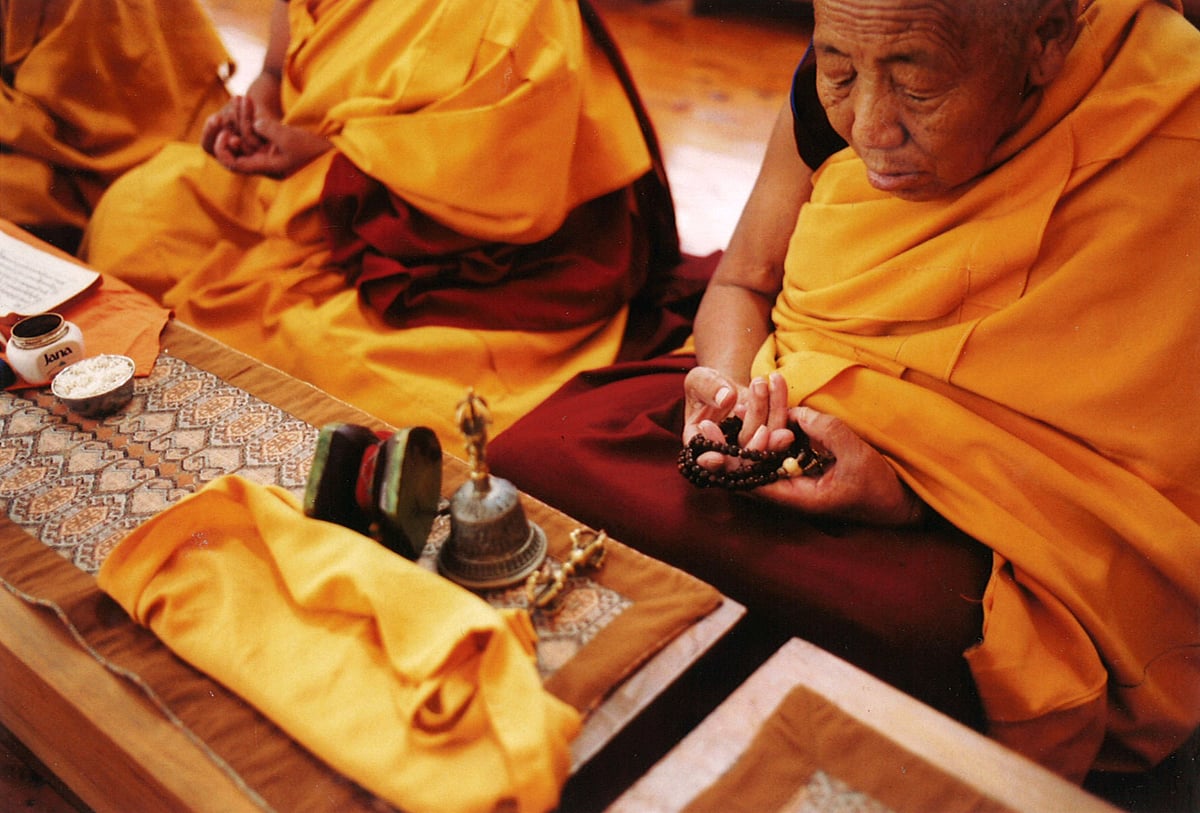
Myths can sometimes be personal. My own such myth stems from a childhood recollection. It involves my Ani, who is a Buddhist nun as well as my father's elder sister. She inhabits, simultaneously and seamlessly, the two opposing connotations of the Tibetan term: one suggesting faith, the other family; the former symbolising renunciation, the latter attachment.
A memory:
I am a seven-year-old boy, having strayed far from my unlikely home in the Tibetan nunnery in McLeod Ganj, Dharamsala. Every winter, my parents would deposit me in the care of my nun-aunt before setting out on their sweater-selling sojourn in some distant city. Without fail, before their departure from the small bus-stand and in full view of the townsfolk, I would protest and I would cry, I would flail my limbs in the air and throw myself on the ground. Still they would let themselves be taken away in a bus, down the hill and out of sight, as though my outbursts were merely for effect – a ritualistic send-off and nothing more.
I am so absorbed in a game of striking flattened soda-bottle caps that I haven't noticed that night has fallen. After school hours, moving from one place to the next, my friends and I have found an impromptu playground on a hardened patch of earth in the neighbourhood below Bhagsu Road, which we call drongseb, for 'village'. Huddled around our scattered riches, in the faint light of a distant light bulb, we wait for another boy to torpedo the bottle caps with his daka, a spherical striker made of lead, when we hear a muffled sound. Travelling through the woods and over the mountainside separating us from the town centre, it comes again, and we realise it's somebody's name being shouted out, truncated by its own echo. Soon I recognise it as my own, followed by, 'Where are you?'