
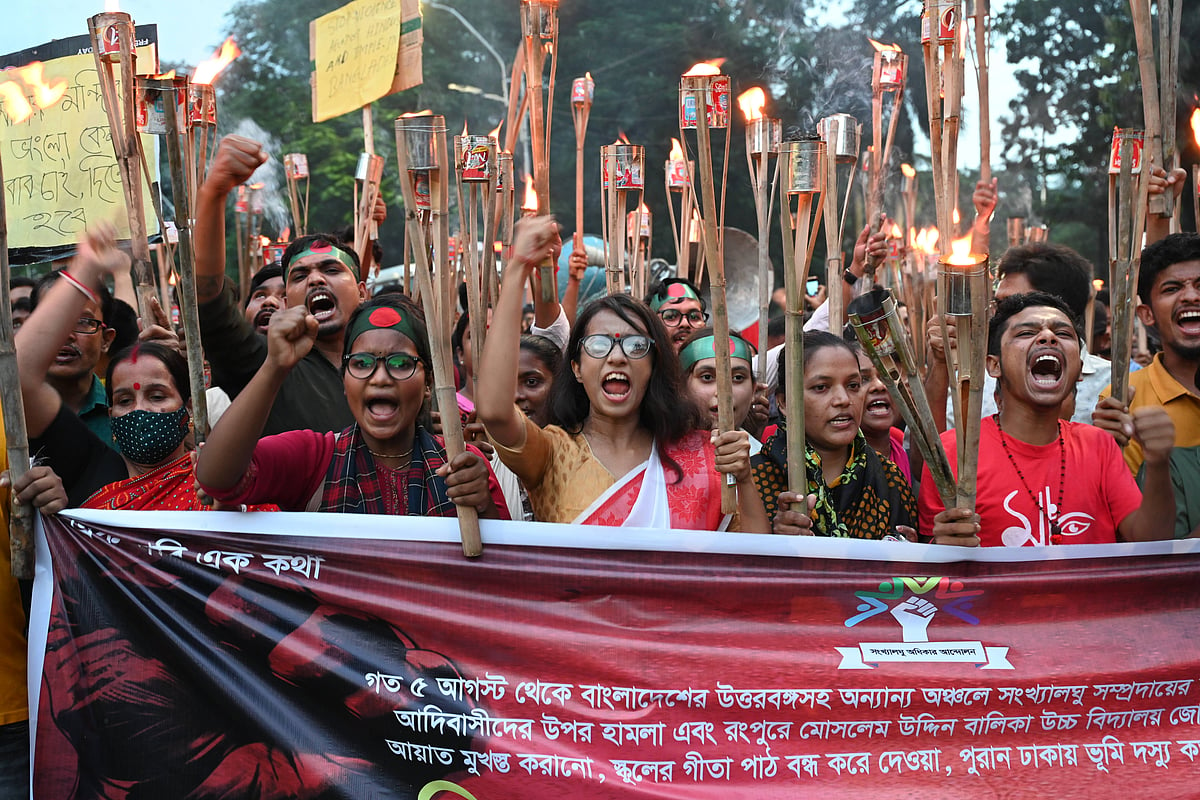
In July, Bangladesh’s prime minister, Sheikh Hasina, greenlighted a brutal crackdown on student protests that led to over 1500 deaths, with thousands more reportedly injured. At least 32 children were among those reported killed by UNICEF between July and August, with the Dhaka-based non-profit Ain o Salish Kendra reporting as many as 121 children killed across 10 months of the student-led movement, mostly at the hands of security forces. This was an extension of Sheikh Hasina’s repressive regime, which crushed dissent and political opposition. Bangladesh’s last three elections, all held under the rule of Hasina’s Awami League, had been rigged, and the main opposition, the Bangladesh Nationalist Party (BNP), often chose to boycott the vote in protest.
For nearly three days after Hasina was ousted, forced to flee the country on 5 August, revenge attacks erupted across Bangladesh. The police, long viewed as enforcers of Awami League repression, became prime targets of public anger. Over 80 percent of police stations were burned down nationwide, and 44 police officers were killed, some of them lynched by mobs. This period marked not only the collapse of the Awami League but also a targeted backlash against its broader apparatus of power – including members of Bangladesh’s Hindu community who had held prominent roles in the party and its affiliates.
As Bangladesh’s interim administration struggles to rebuild Bangladesh’s administration, to restore destroyed police stations and to support those impacted by the violence in the aftermath of Hasina’s fall, data regarding the Hindu community’s suffering has begun to emerge. On 19 September, the Bangladesh Hindu Buddhist Christian Unity Council presented a report highlighting incidents of communal violence after Hasina’s departure. It said that nine Hindus were murdered between 4 and 20 August.
Following the council’s report, Netra News, a reputable investigative outlet on Bangladesh run by journalists in exile in Sweden, thoroughly examined each of the nine reported deaths. It found little evidence to support claims that the victims were targeted because they were Hindu. Rather, it found, the deaths stemmed from political violence, personal disputes or crime, with no clear sectarian motives. Some of the deaths reported even predated Hasina’s departure.