
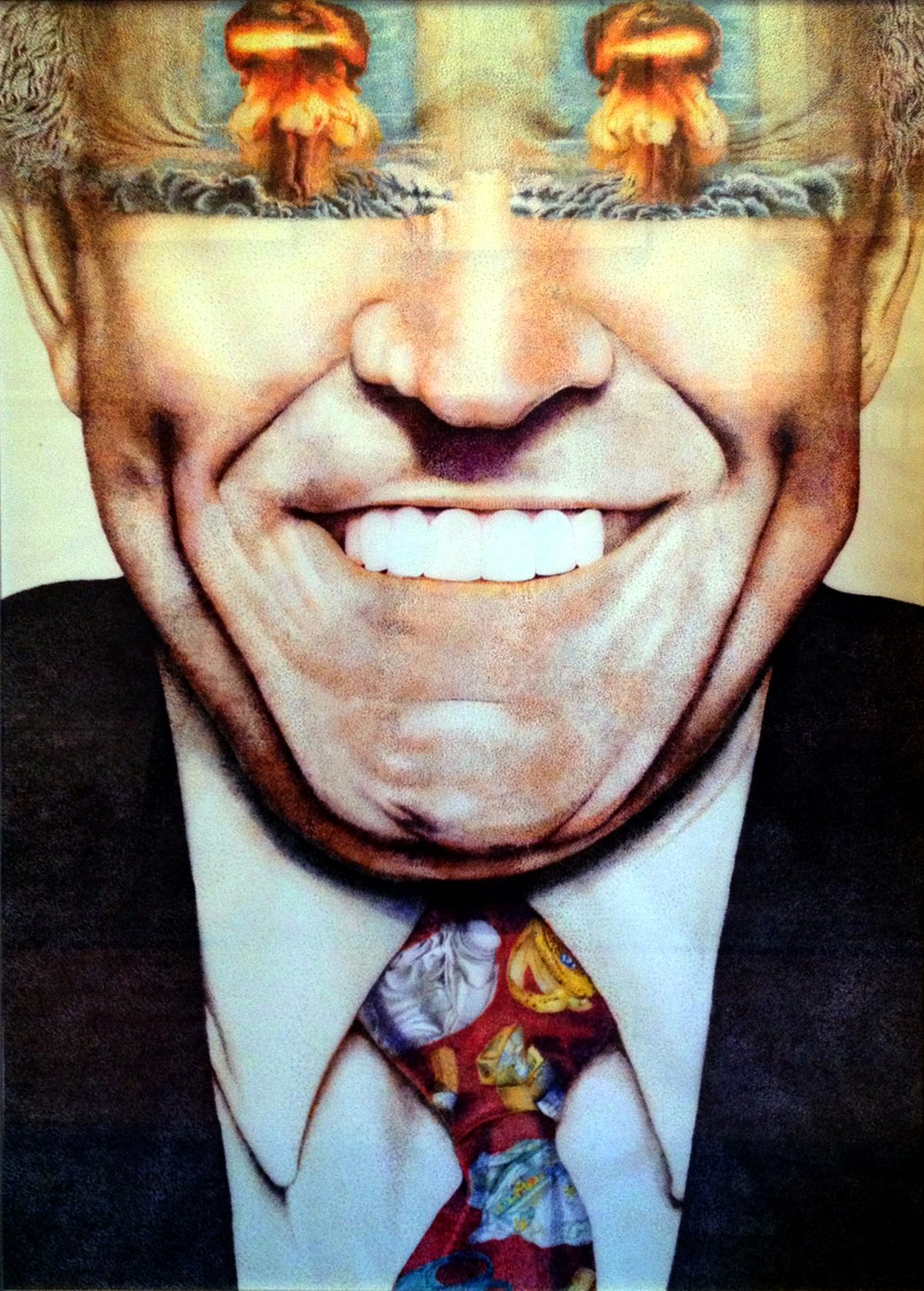
Faiza Butt was one of the artists who were properly launched into the Western art stratosphere with this exhibition in New York. She is now represented by art galleries Rossi and Rossi and Grosvenor Gallery in London. Butt will, however, have no truck with my coinage "Young Pakistani Artist", a term she not only derides but chides me for using. Yet it is convenient shorthand, one she resorts to herself, unknowingly, during our conversation. She would much rather I call her an artist from Pakistan. She reasons that being called a Pakistani artist limits the purview of artists from the region. During our somewhat unorthodox interview in London, perhaps the most cosmopolitan city in the world, she often reiterates that her concerns transcend national boundaries. "It is very important to me that what I make should have universality and no matter where you display it, people should be able to relate to it and read it. It shouldn't be framed culturally as Pakistani or Indian art."
The 'Sensation' moment for Pakistani art may have passed with 'Hanging Fire' at the Asia Society in New York in 2009 where, to neologise, YPAs (Young Pakistani Artists) had the opportunity to display their version of the errant, eye-catching tactics the YBAs (Young British Artists) so effectively tried in the 1990s: Rashid Rana's Persian carpet, which on closer inspection transforms into thousands of miniscule images of slaughter in abattoirs; Huma Mulji's taxidermic cows dangling from pylons or fluted, ionic columns; Imran Qureshi's seemingly harmless but subliminally threatening bearded men; Anwar Saeed's stylised homoerotic images of men in langots; and Arif Mahmood's consternation-filling, gun-toting urchin on a Karachi beach – but, seven years on, its progenitors continue to be in fine fettle.
To compare Butt's work to that of American photographer Robert Mapplethorpe may seem perverse or at the very least bizarre – Butt's work is not nearly as obsessed with the phallic – but given her distaste of boundaries, perhaps we could hazard inviting the comparison. The biggest similarity, albeit a philosophical one, is that like Mapplethorpe, Butt is a voluptuary and espouses the cult of beauty, even if the ways in which they do so is vastly different given their respective milieux. Photography has always been a flattering art. Mapplethorpe once said that all his photographs were altars. It can be contended that so are many of Butt's works – altars to the myth of creation. The comparison should also be acceptable, considering her images veer between photography and painting. Indeed, in many instances, she uses photographs as raw material for the images she then proceeds to cull out of them with her pointillistic technique, which is an extension of Mughal miniature painting, the genre she cut her teeth on at National College of Arts, Lahore. She speaks of the artistic ferment of the institution and lauds the team that taught her there. The careers of several of her very talented contemporaries were launched in simultaneity; today they represent Pakistan internationally in exhibitions at art galleries, museums and fairs the world over.
"It's a very strange story that the most known artists happened to be in our year and this was the early 90s at NCA. I look back and reflect on it: people like Bani Abidi, Risham Syed, Farida Batool, myself, Imran Qureshi, Aisha Khalid, Rashid Rana. Shahzia Sikandar was our senior. So what was going on? I think it had to do with the fact that we had the best faculty that NCA has ever seen in its history. We had Professor Salima Hashmi just come back from Rhode Island School of Design; Quddus Mirza just back from the Royal College having done his masters in painting; we had Zahoor ul Akhlaq; we had Colin David coming in and out; we had Saeed Akhtar teaching drawing; we had this legend, Mian Salahuddin, in the ceramics department," says Butt.