
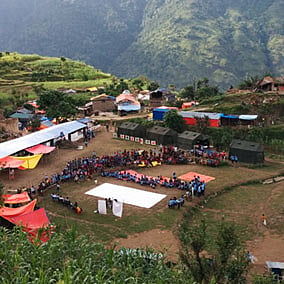
(This article is a part of the web-exclusive series from our latest issue 'Disaster Politics'. More from the print quarterly here.)
Before the Nepal earthquake of April 2015, I had never heard of the town of Ghyachchok. During the weeks after the quake, as I was stationed at the Yellow House, a bed and breakfast in Lalitpur, coordinating relief missions with friends, many names were brought to my attention. Every day, volunteers brought new information from remote neighbourhoods of Kathmandu and the affected districts. Details were updated daily on quakemap.org, an open data platform set up by Kathmandu Living Labs, a company that uses technology to address civic problems. We jotted the details on paper, along with requirements and numbers, and taped them on the outside walls of the Yellow House. "Khadichaur, food and shelter for 150 households, Raju, Tel: 984XXXXXXX." More and more people gathered every day – those wanting to help, and those who needed it.
Ghyachchok, however, came up in a slightly different context. A month after the first quake, the frenzy that had followed had subsided. People were starting to think of alternative ways to help those affected. Towards the end of May, I organised a meeting with the goal of helping children and teachers. Being an educator, and having conducted workshops and training sessions with various groups of teachers in Nepal, I reached out to my network: groups of artists who regularly worked with children, a couple of officers from international organisations such as ChildReach and colleagues who were interested in education, all showed up at the meeting. A mixed group of volunteers and expats, now regulars at the Yellow House, also attended. Later that week, I planned support-group sessions for parents and teachers, and a schedule was posted on the Facebook page that the Yellow House volunteer group had created three days after the first quake. A retired British psychotherapist talked about shock and trauma. A Nepali mother of two played music and made everyone dance. I handed out information on psychological first aid. Sharareh Bajracharya, an arts educator, collaborated with Jess Linton, an art psychotherapist, to demonstrate how art materials and activities can be used to address emotional and mental well-being.
Soon after, the Shikshya Foundation – a non-profit organisation that focuses on education – wanted to meet me. Sharareh and I brainstormed ideas with Kumudini Shrestha and her brother, who were both board members of the Foundation. "It would be great to take some artists and entertainers to the affected rural districts," said Sharareh. "At the very least, we will make the children smile." The Shikshya siblings liked the idea. "We have to be careful though," the brother chimed in at one point. He was concerned that the purpose of the mission that was quickly taking shape might be misunderstood. The brother had a point. People were still without roofs. Would everyone understand the value of art?