
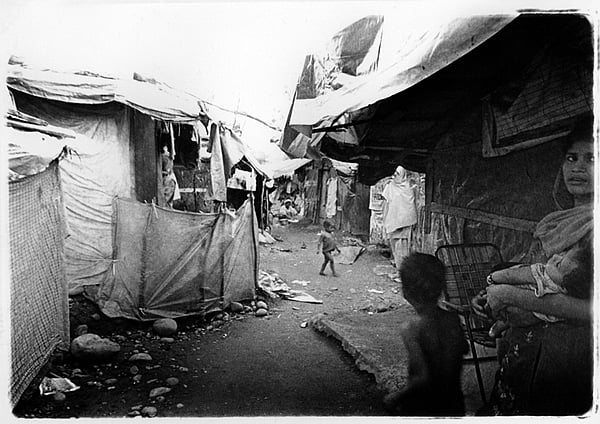
A violent downpour muddies the waters of Kalyani talab, a small pond to which a government primary school and a towering minaret form a backdrop. It is the landmark you are directed to if you want to know the whereabouts of the Rohingyas in Jammu, the Muslim refugees from Burma who settled here on rented land in Qasim Nagar in Narwal, on the outskirts of the city, in 2008. Further down the road the water is streaming down the jute and nylon roofs of the shanty encampment – a tight cluster of huts made of wooden panels, most of them bearing the unlikely mark of Royal Bengal Commercial Plywood. Three provisory stairs, a boulder and two sacks of sand, descend to the camp. The torrent is flooding the narrow passages between the shacks. Its noise smothers the murmur arising from the improvised mosque and madrasa where a group of girls and boys, rocking rhythmically back and forth, are reciting the Quran, placed open on tiny bookracks. The deluge is showering the skinny chickens running around; women are washing clothes and pots at the sewage canals that branch out and trickle through the entire camp like swollen veins.
In one of the shacks an emaciated woman, probably much younger than she looks, is staring blankly through the open door and the rain curtain, with several pills (antidepressants) scattered on the floor in front of her. In another, a young woman, squatting, is holding her day-old child whose umbilical cord is still unsevered. In yet another, a woman is coughing from tuberculosis; a father holding his one-and-a-half-year-old son, whose testicles are drooping down, bigger than his head (hernia, as we later found out, is quite common among them). In a clearing at the end of the camp, several naked children are dancing, welcoming the cloudburst with their heads tilted back, their mouths wide open. The local government shut down their water supply, scarce as it was, in October last year. This is the only water they get –manna from heaven.
The Rohingyas, who had to flee Burma due to persecution, can be found scattered throughout the world. In India, besides in the state of Jammu and Kashmir, they are also clustered in the cities of Delhi and Hyderabad, most likely because these areas have significant Muslim populations. As a (Muslim) minority in India, they are facing discrimination and are under threat of being forcefully displaced or deported by right-wing nationalist forces. In the politically sensitive petri dish that is Jammu and Kashmir, that threat is even more imminent, and the bigger political issues here overshadow the fact that the Rohingyas are a group of asylum seekers made up of mostly women and children.
Inside Mohammad Yunus's hut a group of Rohingya men has gathered. The rain is still very audible, knocking on the roof in a regular staccato rhythm. Yunus is the vice-president of their still unregistered Rohingya Committee, the men gathered around him are its members. When an opportunity arises they are also manual labourers – railway cleaners, garbage collectors, construction workers – while some of them have set up small shops in and outside the camp. "People don't want to hire us, so we work at any jobs we can get. Sometimes they pay us, sometimes they don't," one of the men says. "We have no nationality, so we can't demand anything. We don't even exist."