

Dear reader,
Mother Mary Comes To Me, Arundhati Roy’s long-awaited memoir, is an intimate exploration of love, loss and the mercurial bond between a daughter and the mother who shaped her entire literary life. To guide us through this extraordinary work, via one of Himal’s most ambitious essays of the year, we have the writer and editor Supriya Nair.
Himal’s virtual cover for December 2025 presents Nair’s reading of Mother Mary against the long arc of Roy’s career – taking in her unflinching political fire, her preoccupation with belonging, and her globally beloved novel The God of Small Things. Nair shows how Mother Mary both enriches and unsettles our understanding of Roy’s oeuvre, offering new perspectives on perhaps the most influential Indian writer alive today.
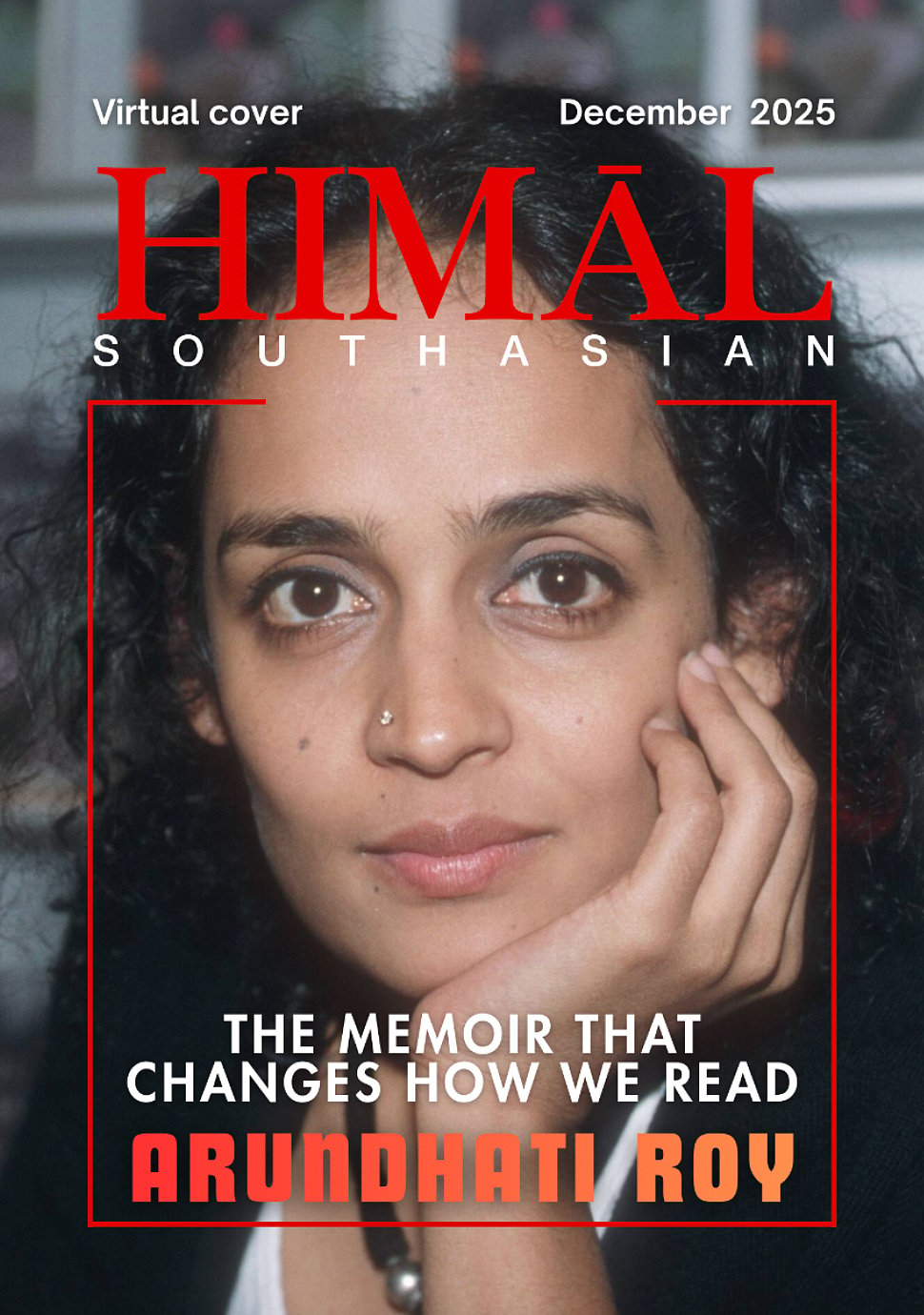
“In the 20 years between her novels, Roy’s work, entirely comprising non-fiction, was called rebellious, radical and revolutionary. The less limiting and categorisable description is disobedience,” Nair writes. “Mother Mary underlines what her fiction has always told us: that cocking the snook starts at home.”
Alongside this, we present four pieces from the Himal archives:
Also read: “India does not mow down its people”: Arundhati Roy in conversation with David Barsamian
David Barsamian’s 2001 interview with Roy has her discussing corporate collusion, environmental struggles and political resistance in India. Roy says of herself and her mother, “The problem is that we are both women who are unconventional in their terms. The least we could have done was to be unhappy. But we aren’t, and that’s what bothers people.”
Also read: Indo-Anglian Writing: The triumphs and pitfalls behind its rise
Nandi Bhatia’s 1999 essay on the triumphs and travails behind the rise of Indo-Anglian writing argues that Roy’s The God of Small Things took Indian writing to new heights of recognition – but that its easy acceptance rested on the work of those who had come before.
Also read: The Goddess of Big Things: Surveying the early critical reception of Arundhati Roy’s debut novel
Jyoti Thottam, surveying the early critical reception of The God of Small Things in 1997, shows how its divergent readings exposed the shared blind spots of both Western and Southasian criticism – and how little Southasians often know about one another’s regional worlds.
Also read: Catharsis as elite obsession: On ‘Listening to Grasshoppers’ by Arundhati Roy
G Narasimha Raghavan’s 2009 essay examines Roy’s essay collection Listening to Grasshoppers, probing the elite practice of literary catharsis and the motives behind activist writing.
Current Indian regulatory restrictions prevent us from processing recurring payments for Indian credit/debit cards. Please select a one-time payment plan from here to continue supporting our journalism.
It’s the support of readers like you that allows Himal to produce in-depth, informed literary journalism on Southasia that you won’t find anywhere else. Become a paying Himal Patron today to help sustain our work as we give Southasian literature the international platform and critical attention it deserves.
All best
Roman Gautam
Editor, Himal Southasian