AMONG THE CHAOS of figures that jostle for space in the British artist George Earl’s 1893 painting Going North is a brown woman tending to a white child as two white men and a white woman – presumably a British family – look on. The scene unfolds in London’s bustling King’s Cross railway station, and the painter’s portrayal of the brown woman suggests she may be from India or elsewhere in Southasia. In the Victorian watercolourist Helen Allingham’s 1877 On Dover Beach, a female figure who could also be read as Southasian supervises three white children – clearly her wards – playing among shallow waves. The creation of both paintings in the late 19th century coincides with the height of British imperialism, when colonial families in India were known to depend on colonised subjects for childcare and other domestic services. It’s not hard to imagine, then, given the decidedly British settings of Earl and Allingham’s paintings, that some of these “native” caregivers travelled with their British employers along the circuits of Empire into the very heart of the metropole.
Adding heft to this assumption are descriptions of these paintings in ‘Ayahs and Amahs: Transcolonial Journeys’, a recent project studying female care workers from India and China who journeyed back and forth with colonial families between the United Kingdom, Australia and Asia. The project’s curators describe Allingham’s On Dover Beach as “a nostalgic portrayal of the world of working women” that “displays the British empire’s dependence on the carework of women of color.” The text accompanying Earl’s Going North describes colonial careworkers as “an integral part of British social fabric in the late nineteenth-century,” and King’s Cross station as “a major public transport hub, taking ayahs who arrived from India north to employers’ homes in Scotland.”
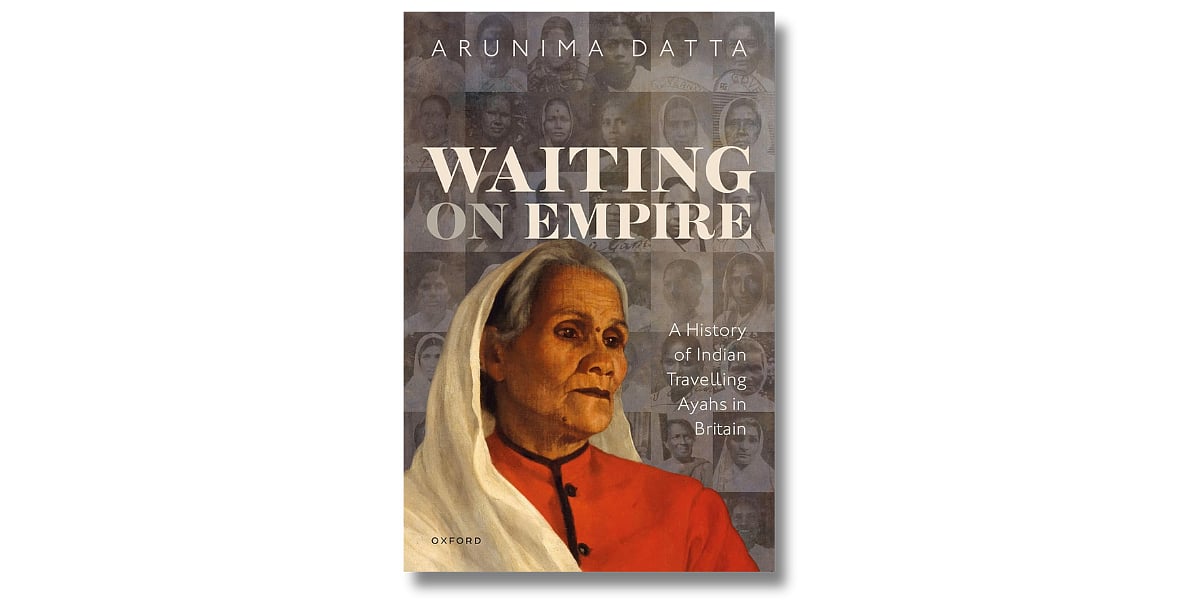
The long-forgotten stories of India’s female colonial caregivers is also the focus of historian Arunima Datta’s latest book, Waiting on Empire: A History of Indian Travelling Ayahs in Britain. Like the women in Earl and Allingham’s paintings, Datta’s subjects embarked on sea voyages to serve colonial families travelling between India, Britain and other imperial destinations. The book intervenes in the fields of labour, migration and diaspora studies, which in recent years have begun to excavate previously neglected histories of colonial migrant workers. But while earlier works have studied indentured “coolie” labourers in far-flung imperial plantations, convict labourers in Britain’s Asian colonies, seafarers on British merchant ships and Indian non-combatants in the British Indian Army whose care work sustained the ranks, they have remained silent on the migrant woman. This is precisely the gap that Datta’s book fulfils. By honing in on the caregiving industry, a profession as dominated by women then as it is now, it rescues some of the most intrepid women travellers of their time from historical obscurity and restores them in public memory. While the first examples of travelling ayahs can be found as early as the 1700s, the book focuses on the 19th and early 20th centuries, when the phenomenon was more visible as hundreds of women made the journey every year between India and Britain.