
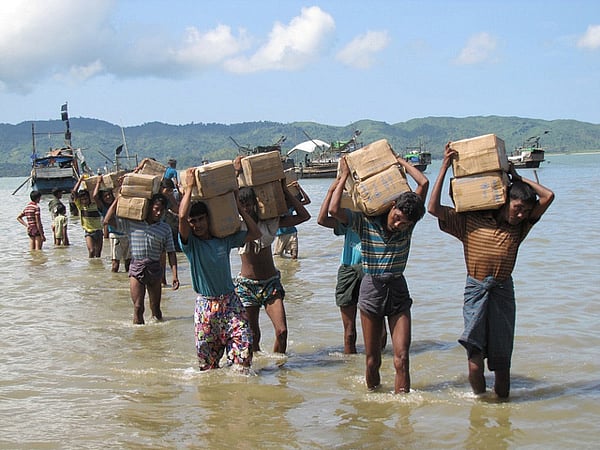
The migrant crisis in the Andaman Sea saw some 8000 people – some Rohingya refugees and others Bangladeshi economic migrants – trapped at sea. The immediate cause of the crisis was Thailand's crackdown on the smugglers, who had until recently facilitated the movement of people across borders. With the Thai border closed, the boats, crammed with their cargo of human misery, were pushed southwards, where they were no more welcome. Indonesia and Malaysia also ordered naval forces to stop the boats from reaching land. Following an international outcry both countries relented, allowing the boats to land. But they immediately repatriated all citizens of Bangladesh and insisted that the Rohingya only have temporary asylum, pending their removal to a final, as yet unspecified, location within a year.
Whilst this crisis has only recently received global media attention, it has been ongoing for years, and is not limited to Bangladeshis or Rohingyas, as Burma has continued to engage in a series of violent civil wars with ethnic and religious groups that reside within its borders. First, the military government and now, more recently, the partially democratised government of Thein Sein, have oppressed not just the Rohingya (although a unique case because the government denies citizenship to this community) in Rakhine state to the west of the country, but also peoples in Kachin, Kayah, Kayin and Shan states to the east, bordering Thailand.
The history of this repression is well known: Burma's military, drawn from the Bamar people who make up almost 70 percent of Burma's population, have engaged an authoritarian state-building exercise, seeking to both centralise political authority in their hands and gain unhindered access to the resource-rich outer regions of the state. The conflicts are complex, often involving multiple competing sides where the motives are part economic, part political and part ethnic. This is especially true in the case of the Rohingya, where they, as a Muslim minority, are in conflict with segments of the Buddhist majority population as well as the central government itself, with all three sides accusing the other of 'stoking the flames'.
The result of these conflicts is also clear to see. Almost a million people have been internally displaced within Burma either through trying to escape the government or because they have fallen victim to centrally organised relocation of population. Some 100,000 Rohingya, who remain in Burma, have been rounded up into camps, dispossessed of their land and livelihoods and dealt with as illegal immigrants. Further, thousands live just across the border in Thailand in migrant camps.