
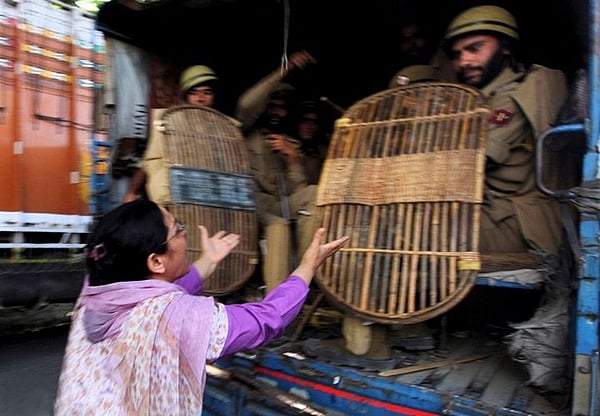
"What should I have told you then?" asked the young Kashmiri woman when activists pointed to gaps in her account of sexual violence perpetrated by a high-ranking police officer. Her poignant question encapsulates the gamut of issues related to sexual violence and militarisation. How does a woman recount her story and get acknowledgment of the brutal violation of her rights when gender-based violence has been an integral part of armed conflict throughout history? How does a woman elucidate on details of brutality when in society sexual matters are considered inappropriate for public discussion and there is a tendency to avoid thinking about such horrors? How does a woman challenge the might of the state when there is a hostile environment for victims and judicial institutions fail to provide safe spaces?
Furthermore, as Dr. Yakin Erturk, former UN Special Rapporteur on Violence Against Women, points out in an article for Open Democracy, "militarised environments empower both public and private patriarchy". Human rights advocates have also pointed out that militarisation facilitates censorship and secrecy, and the rhetoric of 'national security' that accompanies militarised environments is effectively employed to deny people the freedom of expression and avenues to pursue justice.
These observations resonate in Kashmir as well as other militarised regions like Chhattisgarh and parts of the Northeast where, besides extraordinary security legislation, the state actively fosters a climate of impunity. Worse still, the state seems to incentivise such crimes by bestowing honours on many of the accused personnel.
Alleged Perpetrators – Stories of Impunity in Jammu and Kashmir, released in 2012, is a comprehensive report that examines some 214 cases of human rights violations and the role of 500 "alleged perpetrators" – mostly army, paramilitary, and police personnel. The crimes include enforced disappearances, torture, custodial deaths and sexual violence. The International Peoples' Tribunal on Human Rights and Justice in Indian-Administered Kashmir (IPTK) and the Association of Parents of Disappeared Persons (APDP) spearheaded the report in response to the structural impunity that prevails in the highly militarised spaces of J & K. Earlier, the APDP was involved in recording the presence of mass anonymous graves in Kashmir.