
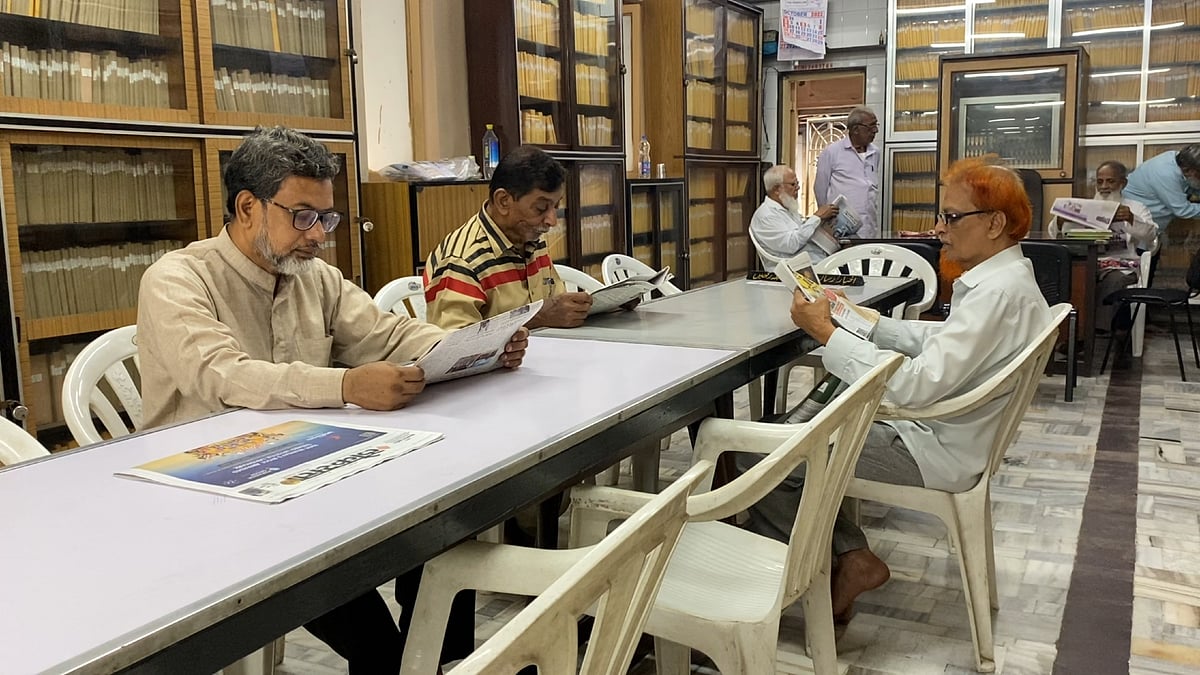
Upon entering the Awami Idara (People's Institution) library in the summer of 2022, I first met the older members of the library peering over their newspapers. Having visited many other Urdu libraries dotted across India, I did not find the welcoming elderly newspaper readers surprising. More unusual, however, was a small but imposing bust of Vladimir Lenin perched above them all, and a hammer and sickle. The iconography reflected the library's Marxist leanings, and its historical connections with the Soviet Union and transregional leftist movements. This history sharply distinguishes what is by reputation Mumbai's largest Urdu library from many other Urdu collections in India.
Indeed, the distinctive mission and history of the Awami Idara are apparent from the moment one enters the library. Open from 6 to 10 pm, the library's hours reflect its historically intended audience – labourers who worked at mills and factories during the day and read and gathered in the evenings. The library is located near the centre of a residential, working-class Muslim neighbourhood in Mominpura, Mumbai. Founded in 1952, it is surrounded by both homes and small-scale mills and factories, and seems designed not to impress visitors but to provide a welcoming, convivial space for local readers. While many readers visit the library to read newspapers or socialise, the walls are lined with thousands of Urdu books which, according to the library's internal catalogue, are shelved in a strict numerical fashion and bound in uniform yellow covers.
In recent years, several newspaper and media reports have celebrated the unique and unusual nature of the Awami Idara, particularly the fact that a leftist library aimed at Muslim mill workers continues to survive and adapt in an era where right-wing Hindu nationalism flourishes. Others focus on the shifting religious ideologies evident in the surrounding neighbourhood, expressing surprise at the lack of conflict between Muslim movements claiming religious orthodoxy – most notably local proponents of the Ahl-i Hadith movement – and the left-leaning library. The fact that the largest and oldest Urdu library in Mumbai is a leftist organisation that once boasted strong ties with the USSR does sometimes seem incongruous in today's political environment.
The Awami Idara is part of a long history of Southasian Muslim labour activism and an often-overlooked Indian Muslim left, rooted in the mills and factories of cities like Mumbai. The yellow-bound volumes lining the walls of the library hold wider histories, connecting the mill worker-readers of the Awami Idara to both local and transregional histories of the left.