
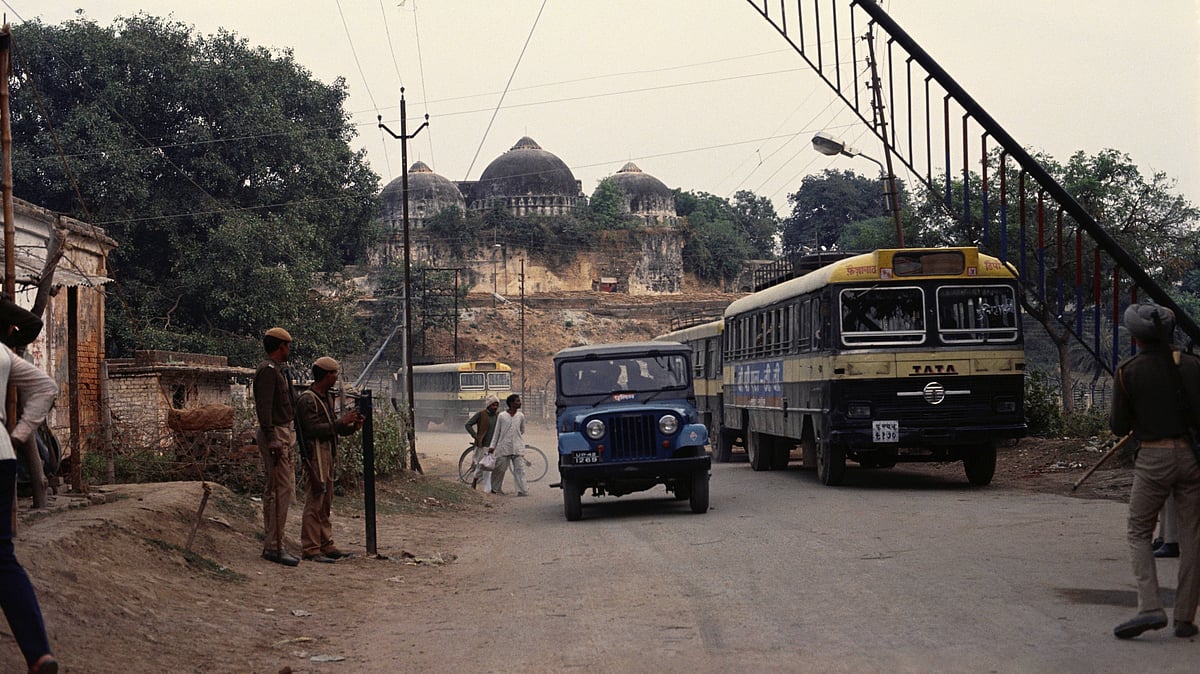
The Babri Masjid was built in 1527 in Ayodhya, in present-day Uttar Pradesh. Some claim that a Central Asian invader and the first Turkic/Mongol emperor of Northern India had this mosque built by demolishing a pre-existing temple – one that stood on the birth-site of Lord Ram (Ram Janmabhoomi). Between 1949 and 1992, various attempts had been made, by action and inaction sponsored by the state, to change the nature of access to the site from the conditions existing before 1949. On 6 December 1992, a large group of communal Hindu activists, egged on by leaders of India's second largest political formation of the time, demolished this mosque. Eventually, on 30 September 2010, a three-judge bench of the Allahabad High Court passed the now famous judgement – the disputed area is to be divided between the three litigants. The Muslim litigant group will receive one-third of the land but not the area under the central dome of the erstwhile Babri mosque structure.
The nature of the Ram Janmabhoomi-Babri Masjid debate shows how much certain parts of Indic society are now prisoners of a historical mode of thinking. This is evident not only in the kinds of arguments and evidence that the court case dealt with but also the talking points that populated the media. People spoke about the past with clinical precision; of scientific evidence, without a shred of doubt, that the divine location of the avatar's birthplace would not transcend evidence-based historical research methods. It would rather be the opposite: evidence-based methods would legitimise the ancient; indeed the timeless. There has been a change in the way crucial sectors of India conceptualise the past; and it is an ongoing process. A clandestine transformation of the nature of consciousness about the past has important implications on our imaginations of the future. It involves, in this case, the possibility that the very soul of our peoples – a plural soul – will undergo degeneration.
Communities living in close proximity trigger anxieties of self-demarcation, such as the 'Islamic' in India against the 'Hindu' backdrop. They also figure out ways of mutual tolerance, which is not necessarily borne out of brotherly love, but in order to coexist without being at each other's throats all the time. A crucial enabler is time – time that heals, muddles, blurs and creates memories. This is the stuff of past consciousness that permeates the present in all its imaginative creativity – creating cross-faith interactions and encounters that put scripture-peddlers of 'pure' religion to shame. Unchangeable scriptural words in India change, take myriad forms and meanings and still remain as ancient, as believable, as certain, eternal and final.
The disputed piece of land in Ayodhya, has two major contenders, ostensibly representing Hindu and Muslim interests and sentiments (though there are minor contenders too such as the Buddhists and Jains). There are, however, other, uncomfortable contenders of a different sort. At least six other sites with structures, in and around Ayodhya, are unencumbered by mosques on top of them, and are believed by numerous Hindus to be Ram's birth-site. Hence, the claim that the real Ram Janmabhoomi is exactly where the Babri Masjid stood necessarily involves dismissing the claims – and inherent sacredness – of these other contenders to Ram Janmabhoomi-hood. This faithless claim of exclusivity runs antithetical to the vital force of hitherto dominant Indic style – where the quality of being sacred has a very distributed geography. In Thailand, for instance, exists the old imperial capital city of Ayudhya or Ayuthhaya, which might be as potently the city of Ram as any other. There's no order of precedence here; indeed, it is a matter of faith, not chronology. The presence of so many sites of Ram hence points to a largely non-exclusive belief.