
(This article from our archives is a part of the web-exclusive series on our latest issue 'Disaster Politics'. It was first published in March 2011. More from the print quarterly here.)
With a coastline of more than 580 kilometres, Bangladesh is exposed to all sorts of water-induced disasters – floods, tropical cyclones (on average 16 times a decade), tornadoes and tidal 'bores', the latter a rare phenomenon in which a massive tide rapidly moves up a river course. While Bangladeshis have, over the decades, learned to live with all sorts of natural calamities, the 'experts' today remain hard at work experimenting with the best possible 'solutions' to such situations. The catch is that they do so without fully considering the actual needs of the people. While the country's cyclone shelters have received wide attention – and for good reason – now is the time to go beyond this approach.
A mature cyclone releases the energy equivalent to many Hiroshima-level bombs. Cyclones typically arise before and after the monsoon (in Bangladesh, April to May and October to November) over the Indian Ocean, and then travel up to the Bay of Bengal. Because Bangladesh is situated at the end of the funnel-shaped bay, with most of its deltaic plains less than 10 metres above sea level, it is highly vulnerable to cyclones. To make matters worse, about 10 million Bangladeshis live in areas almost the same height as the surrounding water – less than a metre above sea level. While cyclones hit Bangladesh with relative infrequency, the low-lying land and the country's weak infrastructure mean that they bring widespread devastation when they do occur. Even though just five percent of cyclones form in the Bay of Bengal, they result in more than three quarters of the world's loss of life and property.
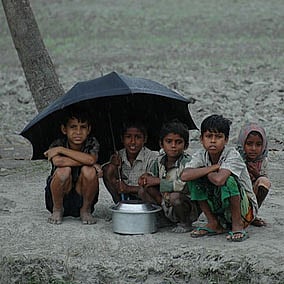
In the span of a year and a half, two major cyclones struck Bangladesh – 'Sidr' on 15 November 2007, and 'Aila' on 29 May 2009. The former caused 3000 deaths, only to be followed by Aila, which devastated many areas that were yet to recover from Sidr. After Aila, anywhere from half a million to two million people were forced to leave their homes for temporary shelters, as huge tidal waves came crashing in with winds gusting at 100 kilometres per hour. But not everyone moved to safety in time. It is estimated that at least 200 people died, 1120 went missing, and some 200,000 people were forced to deal with stagnant water. Even a year and a half later, many local communities did not have sufficient drinking water, while many were unable to find burial places for those who have passed away.