
On the night of 12 January, thousands of students gathered on the campus of Jahangirnagar University, one of Bangladesh’s leading public universities, located on the outskirts of Dhaka, for an open-air concert by a popular rock band. Organised to mark the university’s Annual Day, the show continued well past midnight. Students sang and danced in unison, many visibly euphoric. Among them were large numbers of female students, many wearing hijab – the Islamic headscarf.
The hijab has become a common sight on Bangladesh’s university campuses only over the past two decades. Its use among women students has risen sharply from the early 2010s. Rare in the 1980s, veiling expanded with the growth of Islamic revivalism from the 1990s, and the hijab is now widely worn by young, urban, educated women, including many with no direct links to Islamist politics. This shift towards public expression of Islamic sentiment on campuses was on prominent display on 1 February 2025, when hundreds of students took part in a “hijab rally” at Dhaka University.
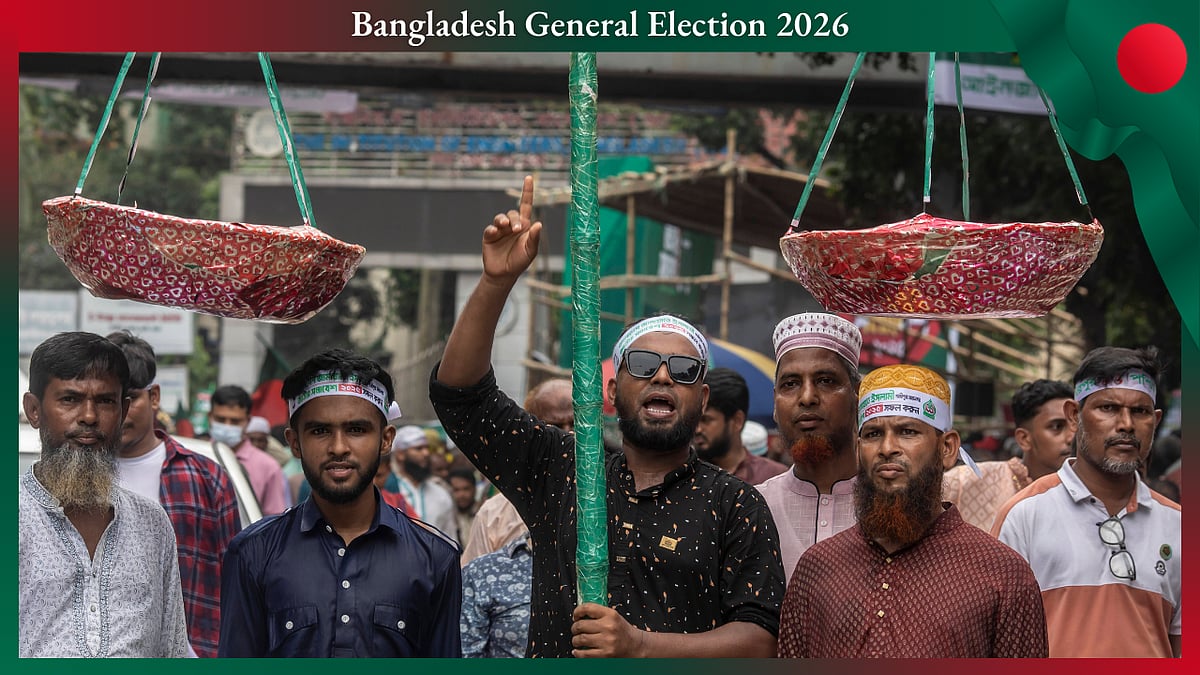
What had been a gradual shift towards political Islam on university campuses culminated in a watershed moment in September. The Islami Chhatra Shibir – the student wing of the Jamaat-e-Islami, Bangladesh’s largest Islamist party and a long-time advocate of a conservative social order – swept the student union elections at Dhaka University – long regarded as a crucible of secular nationalism and leftist politics, and historically a no-go zone for overt religious mobilisation. Since then, the Jamaat-e-Islami’s student front has won all five student union elections held at major public universities.
“This coexistence of an Islamist electoral victory and a campus music concert reflects a broader shift underway in Bangladesh,” Rakib Ahmed, an associate professor of journalism at Jahangirnagar University, said. “Student activists and Islamist groups are increasingly converging ahead of the national elections scheduled for 12 February.”