
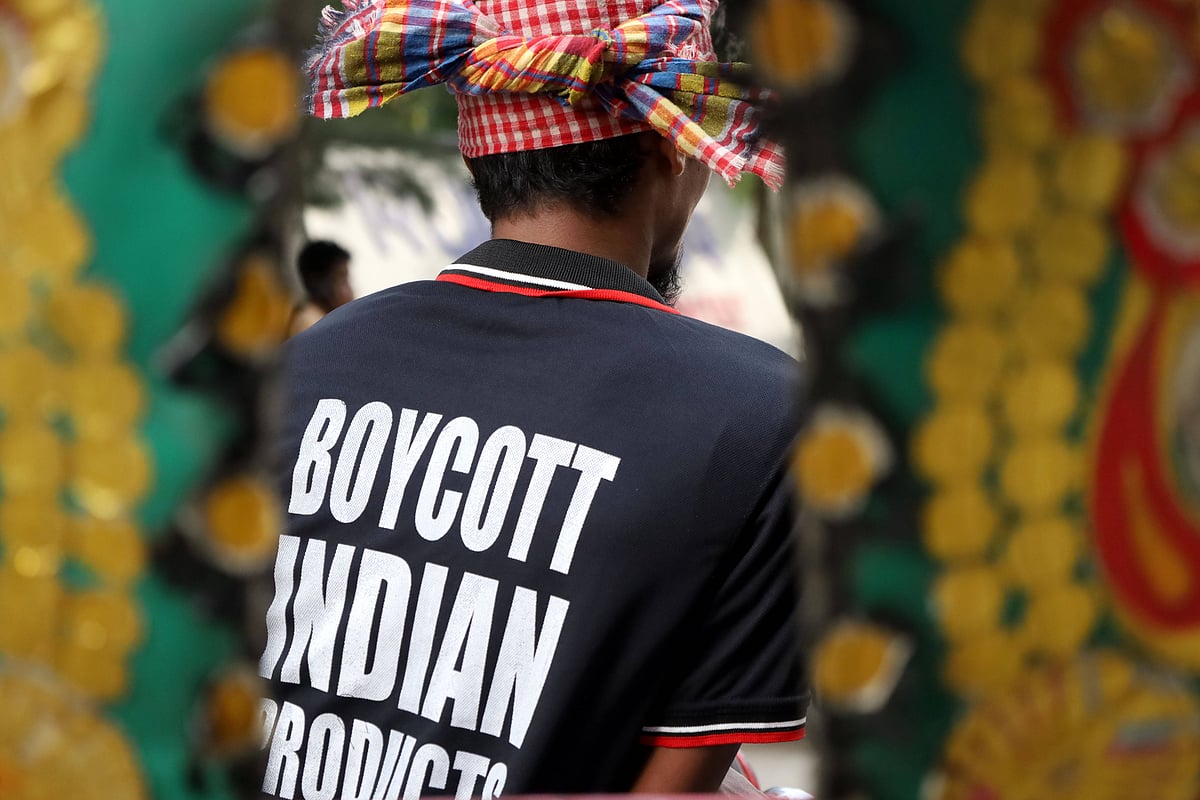
Days after the general election in Bangladesh this January, Pinaki Bhattacharya, a Bangladeshi physician, video blogger and provocateur, urged his online followers to boycott Indian products. Bhattacharya, who relocated to Paris after he was allegedly targeted by Bangladesh’s military intelligence, runs a massively successful YouTube channel. He claimed that calling for “India Out” was a show of defiance and resistance against India’s hegemony over Bangladesh – and, more explicitly, against its support for the ruling Awami League.
In the election, the Awami League and its leader, Sheikh Hasina, swept back into power after the biggest opposition party – the Bangladesh Nationalist Party (BNP)– boycotted the vote following a crackdown in which hundreds of its members were arrested. Hasina’s Awami League government enjoys substantial support from the Indian regime. This was evident when India, which assumed the G20 presidency for 2023, invited Bangladesh to the summit. This was the first time Bangladesh received a G20 invite and was the only Southasian country included. In the run-up to the election, New Delhi backed Hasina’s government by opposing international criticism of its tactics and by lobbying for continuity of government in Bangladesh with the United States for security and economic reasons. The Indian prime minister Narendra Modi also offered enthusiastic congratulations to Hasina after her re-election.
Only months earlier, Mohamed Muizzu had won a presidential election in the Maldives to become the country’s new head of state after campaigning on a largely nationalist and anti-India platform. Bhattacharya’s appeal to boycott Indian products has grown into an India Out campaign similar to the one in the Maldives, and now the BNP wants in.
The BNP was initially on the fence about the campaign. However, in a show of solidarity in late March, the senior BNP leader Ruhul Kabir Rizvi threw his Indian-made shawl to the ground at a press conference. In response, the Awami League said that “the people” will boycott those who boycott India. Taking a jab at her opponents, Hasina has challenged leaders of the BNP to burn their wives’ Indian saris if they are true to their claimed cause. All in all, the campaign’s success so far has been largely rhetorical. In practice, many Bangladeshis are still buying Indian products.