
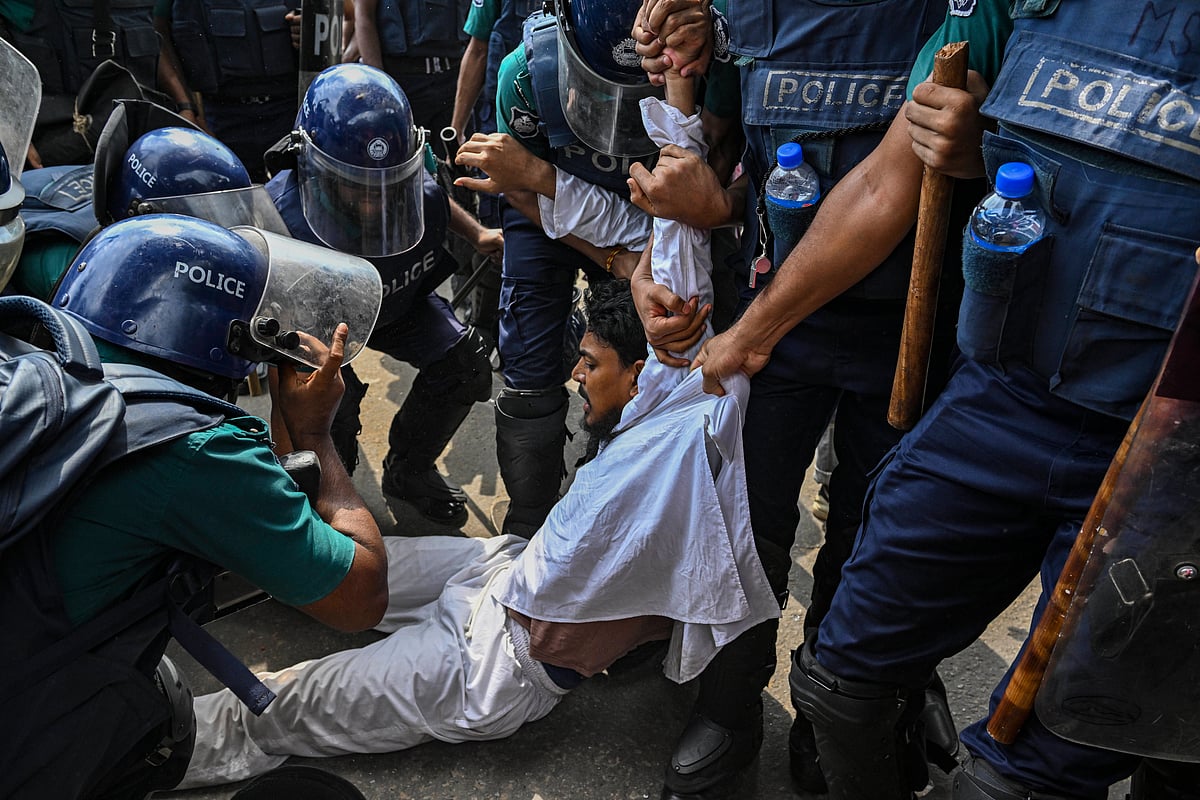
“ARREST THE RINGLEADERS of the protests, the troublemakers, kill them and hide their bodies.” This was the order Sheikh Hasina gave to security forces at the height of the protests that rocked Bangladesh last summer, according to the just-published report of a United Nations fact-finding mission.
Coming from the UN’s Office of the High Commissioner for Human Rights (OHCHR), the report anchors the widely-accepted narrative of Hasina’s fall: that she brutalised her own people right up to the end, after 15 years of unrestrained state capture. It will therefore make for difficult reading in New Delhi, which stood by Hasina throughout, and in the hiding places around the world of her exiled supporters. But the report also offers a sobering corrective to Bangladesh’s interim government, led by the Nobel laureate Muhammad Yunus. It paints an unflattering picture not just of the Hasina government’s brutality but also of the interim government’s failure to stop abusive practices that continue to this day.
The UN report has made waves in Bangladesh, where the interim government has welcomed its corroboration of what happened in July and August 2024. Containing damning evidence of the Hasina government’s complicity in atrocities on a massive scale, it will make it much harder for the former prime minister’s party, the Awami League, to make a comeback in Bangladesh any time soon. It will also make it difficult for her backers in New Delhi to continue their implicit support for the ousted government. Although the Indian government is currently providing asylum – unlawfully – to Hasina and a number of her ministers, the report makes it clear New Delhi backed the wrong side. It might even nudge India to rethink its Bangladesh strategy at last, amid mounting tensions between the two countries. In a sign of Hasina’s lasting potency as a subject of hatred, just last week a mob in Dhaka demolished a museum dedicated to Sheikh Mujibur Rahman, her father and the founding president of Bangladesh. This came after Hasina made an incendiary broadcast from her new home in Delhi.
The UN fact-finding mission interviewed over 200 participants in the protests, belonging to both the old regime and the new one. It was also granted full access to almost all the centres of power in the country – except the army and its intelligence network, the Directorate General of Forces Intelligence (DGFI). Consequently, the report has yielded some significant findings, which are relevant to post-uprising Bangladesh too.