
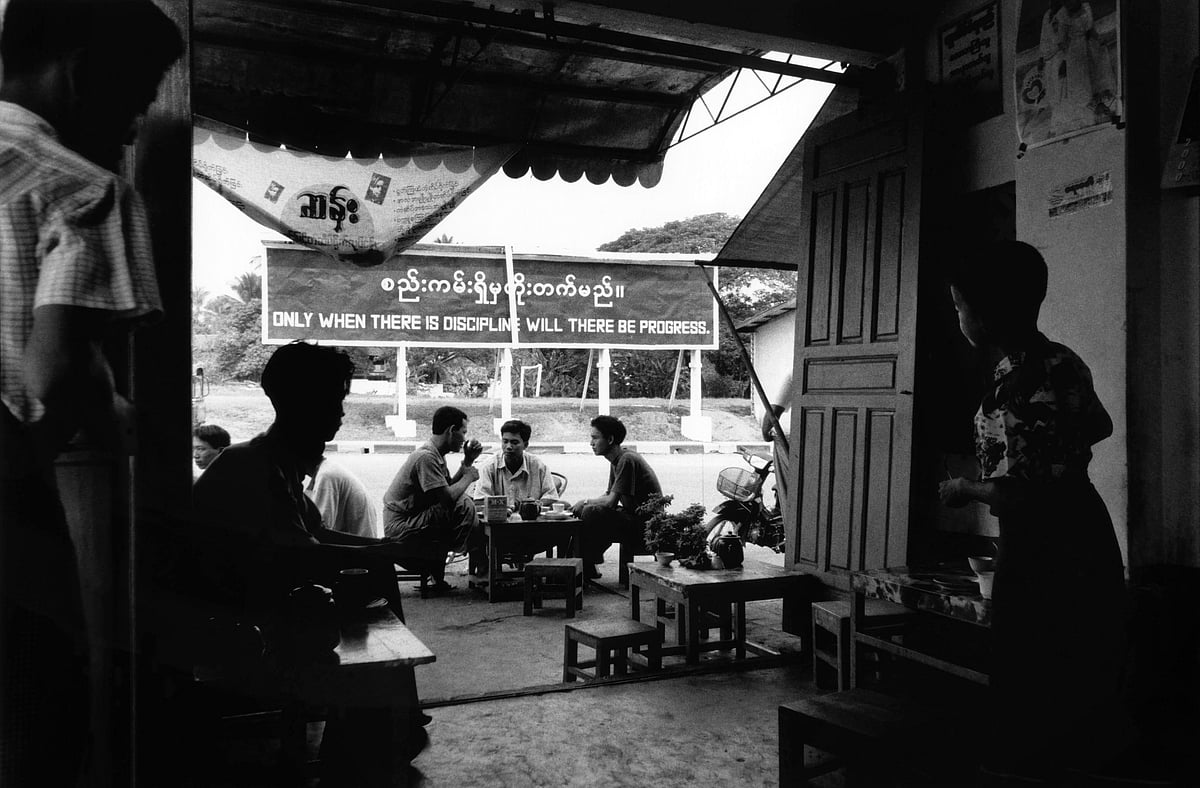
In 1996, I found myself on a train to Mon State in Burma. Our progress was glacial as the ancient carriages swayed and groaned along uneven tracks. Hours into the journey, while I gazed at the beauty of the landscape, the train came to a halt and I could hear the sound of clinking metal. I looked up and saw an enormous quarry, carved out of the hillside, surrounded by watch towers. Groups of men were working under the nonchalant gaze of guards with rifles. The chains around their legs rattled as they crushed rock under a blazing sun. Their movements were slow. I went to grab my camera. The carriage suddenly lurched forward and the apparition disappeared from the window, replaced, once again, by the green countryside.
Prisoners carrying out hard labour was not, in itself, indicative of Burma's situation; but thousands of activists had been thrown in prison as common criminals. Often they were sent to labour camps like this one. Some died from torture and beatings. That is how it was in Burma. One minute I'd see something, the next it would vanish. Such fleeting glimpses left me questioning what I had witnessed; like the time I saw a man being taken away on a Rangoon street or a group of chained men being marched along a road in the Ayeyarwady Delta. These momentary glimpses were just enough to disturb the picture-post card image of a country that the military junta wished to promote.
Four years earlier, in 1992, I was just starting out as a photographer and had run out of money. I was offered a place to stay with the Jesuit Refugee Service in Bangkok. There I met political exiles, mainly students, who had fled the 1988 crackdown in Burma. We were the same generation and I remember thinking that had I been born in Yangon, I might have been one of them.
It was from that compound that an English-language magazine called the Irrawaddy was born. Run entirely by these former students, it set out to provide a 'Burmese perspective' on the situation in the country. Later, they often supported my trips inside the country in exchange for the use of the photographs. As a foreigner, I was in a privileged position; I could traverse the country and gather photographs that ordinary Burmese citizens could not.