
Dear reader,
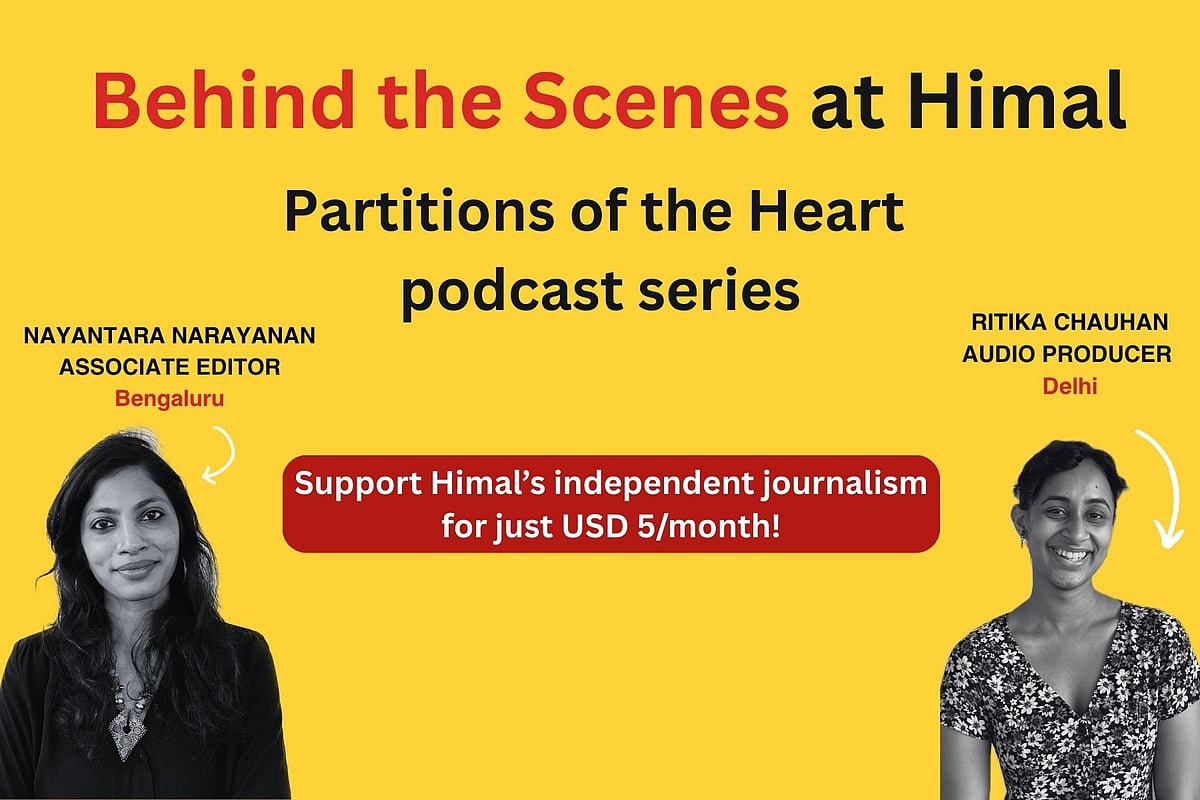
Hello from Nayantara and Ritika! We’re writing to you just as we wrap up Season 1 of our special podcast series ‘Partitions of the Heart’. We’re the team behind the scenes bringing these conversations to life – Nayantara as an editor, and Ritika as audio producer.
When the Indian writer and peace activist Harsh Mander first approached us in March this year with the idea of a podcast series delving into the deepening crisis of Muslims in India, we were thrilled by the chance to bring you essential conversations on one of the most urgent issues facing India and Southasia today. It’s been an education and an adventure for us to produce the series, and a pleasure to have you along.
With the rise and rise of hatred targeting Muslims in India, especially since the country elected a Hindutva government in 2014, Harsh has been at the forefront of the battle to save India from the ravages of communalism. As the host of ‘Partitions of the Heart’, in his conversations with some of the most perceptive Indian Muslim voices today, he draws out personal stories that go beyond cold academic jargon to show not just how the continued persecution of Muslims in India is unfolding, but also how it feels to be on the receiving end of such hatred.
In putting together the list of Harsh’s guests, we wanted to include a broad spectrum in terms of age, gender and life experience. We had the 94-year-old historian Irfan Habib, who was 19 at the time of Partition and recalls vividly the conversations that went into shaping India’s constitution and professed national identity as a secular democracy. The season also featured 27-year-old Afreen Fatima, who experienced first-hand India’s punitive policy of demolitions targeting Muslim homes and businesses.
Imaad ul Hasan, a filmmaker and writer who helped produce the podcast, noted that Season 1 of ‘Partitions of the Heart’ brings together Indian Muslims across the spectrum in terms of class, age and ideology to tell their own stories at a time when they are being invisibilised in society.
Imaad grappled with his share of technical challenges for the podcast, from having to record episodes with brand new microphones that hadn’t been tested to shooting four video episodes back-to-back in two days, trying to accommodate fluctuating lighting, dying camera batteries and shifting schedules. “This was also because we took the decision to try to shoot the episodes in people’s homes where possible, creating a sense of intimacy that added to the free-flowing conversations that followed,” Imaad said.
Despite the challenges, it has been immensely rewarding for us to produce these conversations, and to see the diversity of opinions among Muslims in India. And if you’ve been a regular listener, we hope you’ll support our work, so we can keep bringing you more.
In the process of working on this podcast series, we’ve all picked up new skills. For Ritika, it was learning video-editing. And Nayantara worked to slip in additional context for listeners outside India, in the glossary tucked away in the episode notes, listening closely to make sure everything was sounding smooth. “In the process of editing and producing the series, I’ve listened to every single episode more than once. It was difficult to mark up cuts. I got very invested!” Nayantara said.
We’ve come to better understand the depth of the crisis in India. As Afreen says in her podcast episode, Indian Muslims today resist simply by coming out into the world every day, despite the persecution they face. ‘Partitions of the Heart’ reveals that the story of Muslims in India is not about the maintenance of law and order, but rather about navigating through life despite ever-present fear.
After all the encouragement and great feedback we’ve heard in response to Season 1, we’re now plunging ahead with Season 2 of ‘Partitions of the Heart’, which will focus on another aspect of the crisis of communalism facing India: the history and motivations of the Rashtriya Swayamsevak Sangh (RSS), the ideological fount of Hindu nationalism and the organisational parent of the Bharatiya Janata Party, as well the enduring impacts of Hindu supremacist ideology on Indian society.
We’ll keep you posted on Season 2 as we get closer to its launch in September. Until then, we hope that you keep listening to Himal’s podcasts, and sending us your thoughts and feedback on our work by writing to nayantara@himalmag.com. We’re listening!
Sincerely,
Nayantara and Ritika