
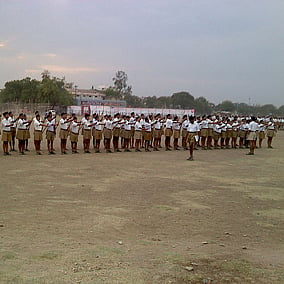
At the VHP office in Ayodhya I met a man who prided himself for being part of the mob which demolished the Babri mosque on the morning of 6 December 1992. Unfortunately, for the 58-year-old Hazari Lal, he fell down along with one of the tombs and was buried in the debris. After he was rescued and many surgeries and a few jail terms later, he seems to be doing okay – except for a limp, a weakened right hand, and a damaged left eye, which has turned gray and sightless. He has never hated Muslims, he clarifies; in fact, his Teli ancestors, who spent their lives crushing oil, were themselves at the oppressed end of the caste system. Lal became passionate about the idea of a Ram temple after he first heard about the issue in the early 1980s at the RSS shakha in his village in Shahjahanpur, 300 kilometres west of Ayodhya. "There'll be a temple here before I die," he said with a faint smile, as he guided me around a replica of the temple that the VHP wants to build.
On 9 January 2016, BJP leader Subramanian Swami organised a two-day seminar at Delhi University. The aim of the seminar was to canvass support for building the Ram temple at Ayodhya. However, the response was muted with most participants agreeing that nothing could happen till the Supreme Court gave its verdict on the disputed land. In 2010, the Allahabad High Court had ruled that the site should be split into three parts – one each for Hindus, Muslims and the Nirmohi Akhara, a sect that represented the god Ram himself in the court proceedings. But the Supreme Court, in 2011, suspended the High Court ruling after the Hindu and Muslim groups appealed against the verdict. My trip to Ayodhya almost coincided with Swami's seminar. Among the people I met there was Acharya Satyendra Das, the head priest at the makeshift Ram Janmabhoomi temple. Das declared: "Jab tak rajneeti nahi hategi, mandir nahi banega." (A temple can't be built until we remove politics from the equation.)
From Ayodhya, I took a train to Nagpur; and given the Ayodhya movement was RSS' brainchild, the journey felt like I was travelling back in time. In Nagpur, I met Dilip Deodhar, a businessman and a popular RSS analyst. Deodhar said, "It is Congress that is to be blamed for Ayodhya." Deodhar meant it was Rajiv Gandhi, as the prime minister in 1986, who ordered the locks to be removed on the disputed structure to allow Hindus to worship there. It had all begun in 1983, when Congress leaders Karan Singh and Dau Dayal Khanna first proposed to VHP the idea of making a Ram temple in Ayodhya. In the general elections following Indira Gandhi's assassination in 1984, Congress received an unprecedented electoral success; BJP was on the other hand reduced to its lowest total ever: two. Not only had RSS not helped the BJP electorally, but had driven disenchanted RSS volunteers to vote for the Congress in large numbers.
In 1989, Banwarilal Purohit, then a Congress MP from Nagpur, had arranged for two secret meetings in Nagpur between one of Rajeev's ministers, Bhanu Prakash Singh, and the RSS. "Deoras had a shrewd political brain," Deodhar said. "He told Congress, 'give me Ayodhya without any conditions attached, and we will offer you full support in the election'." This obviously pained the BJP, especially Advani, who had replaced Vajpayee in 1986 as the party president. In September 1990, Advani commenced on a rath yatra, from Somnath, Gujarat. The intention was to reach Ayodhya, criss-crossing states and drawing followers, by 30 October. Even though Advani's Chevrolet-chariot was stopped in Bihar, the rath yatra made it clear that BJP wanted to desperately reconcile with its ideological mothership. Two years later, economist-turned-journalist Arun Shourie, who was a guest at the RSS Founders' Day in October 1992, advised the parent body to heavily exert its influence on the BJP: "Right now, it seems as if you have cut the umbilical cord."