
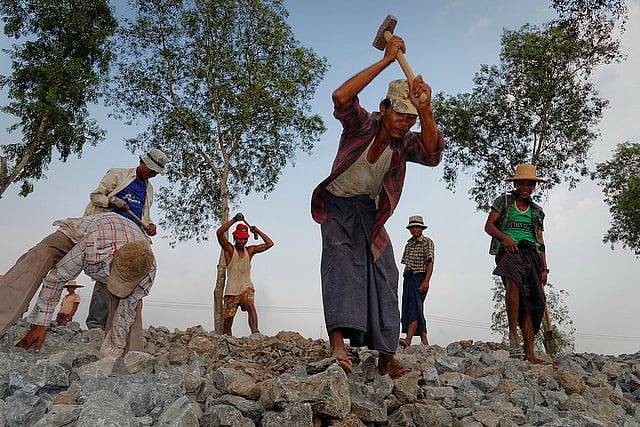
Recent months have seen an increase in organised labour strikes in Myanmar, several of which have been met with violence. On 15 October 2018, a group of workers on strike outside the Chinese-owned Fu Yuen Garment factory in Yangon's Dagon Seikkan township faced a violent attack. While this particular dispute was resolved, following the intervention of the regional minister, trade union activity itself is a relatively recent development.
Trade unions were banned in Myanmar under the military junta, but have begun to organise since the restoration of democracy in 2011, demanding better pay and working conditions. However employers have so far been able to exploit legal loopholes to their advantage. Local law enforcement, too, has been accused of turning a blind eye to the violence directed at protesting workers.
We interviewed author and academic Stephen Campbell on these and other issues impacting labour in Myanmar. Campbell, who authored Border Capitalism, Disrupted: Precarity and Struggle in a Southeast Asian Industrial Zone, is an assistant professor at the School of Social Sciences at Nanyang Technological University, Singapore. His research addresses questions of state formation, borders, migration, capitalism and workers' struggles in Myanmar and Thailand.
Himal Southasian: Myanmar has seen a spate of labour protests in recent months, including the one at a garment factory in Yangon from August to October in 2018. Can you tell us about these protests and strikes?