
There are two worldviews governing the relationship between an editor and the state. One firmly believes in a model wherein the editor considers himself the natural opposition to the governing regime, while the other sees the role of an editor as part of a nation-building agenda. The latter does not consider spaces of mutual cooperation and even collaboration a breach of journalistic ethics. While both approaches have advantages as well as disadvantages, postcolonial Indian journalism did gain substantially from both forms.
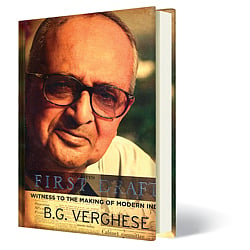
B G Verghese, one of India's seniormost journalists, clearly belongs to the second school of thought. What makes him stand out from the pack, however, is his finely tuned ability to distinguish right from wrong: he is able to define the line between engagement with the state to further the public interest, as opposed to lobbying for narrow personal or business interest. Over the years, Verghese served as bureau chief for the Times of India's powerful Delhi bureau, and later as editor of the Hindustan Times (1969-75) and the Indian Express (1982-86). His memoirs, spanning the entire gamut of independent India's media, are a gentle reminder of the ways in which a journalist can, ethically and morally, work in tandem with the state apparatus. First Draft shows us that such association with the powers-that-be is vastly different from that of the New Delhi journalists who have been disgraced by the Radiagate Tapes.
The two differing worldviews did not in themselves shape modern journalism in India; the profession also had nuances added to it by two sets of editors: owner-editors and employee-editors. The Hindu from Chennai was the first publication to clearly establish the idea of owner-editors, which was later followed by many publications, including Ananda Bazaar Patrika, The Telegraph, India Today and Malayala Manorama. The operational elbow room available to owner-editors, their privileged perch in looking at editorial content and marketing strategies, and their inherent power to negate the views from the marketing arm (as The Hindu did by rejecting advertising from Dow Chemicals in 2009 to express its solidarity with the Bhopal Gas tragedy victims) have given their publication an aura of editorial primacy. In the case of employee-editors, every individual editor had to work with the owners to balance the professional creed and the owner's desire for profits.
The relationship between K K Birla and B G Verghese in the Hindustan Times, read along with Vinod Metha's recollections of his equations with Vijayapat Singhania (Indian Post) and Lalit Thapar (The Pioneer), are a revelation of the thin ice on which employee-editors skate on a daily basis. The deadly combination of media, market and politics creates endless minefields which have ambushed many a worthy editor. The lateral induction of stars undermining the authority of the editor is also brilliantly brought out by Verghese, as in the case of Arun Shourie in Indian Express. First Draft provides an opening for a vigorous debate on how media houses are run in the democracy that is India. This is a matter that has become a topic of urgent concern after the revelations of Radiagate, in which the journalists at the highest echelons fix political appointments and commercial deals.