
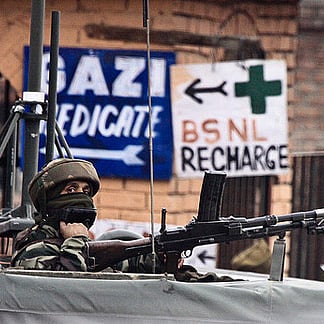
In any conflict zone, it is the common person who pays the greatest price and becomes a casualty in one way or another. Since 1989, ordinary Kashmiris have often found themselves suspended between two guns – one wielded by the state; the other by non-state actors. During election processes – which remain deeply contentious in Kashmir – people find themselves in a Catch-22 scenario, forced to choose between casting a vote for 'better governance' or boycotting the process in order to 'honour the sacrifices' made in the struggle for self-determination. Recent elections were no exception. For Kashmiris, not only was it a battle between the ballot and the boycott, it was also a battle between forgetfulness and memory: violence, aggression, rhetoric, and deceitful politics have been used to lure potential voters, or alternately, coerce them to stay away from the process in the name of resistance.
In the state of Jammu & Kashmir, six parliamentary constituencies held polls in the recently concluded Indian General Elections. Unfortunately, Kashmir lost many civilians and lower-rung political activists to the region's vicious cycle of violence. On 30 April, at the end of polling in the sensitive constituency of Srinagar-Budgam-Ganderbal, a young mason, Bashir Ahmad Bhat, lost his life as a result of the Central Reserve Police Force opening fire on a group of youths in the Nawakadal area of Srinagar. The State Human Rights Commission termed it an "extra-judicial killing". Twenty-eight-year-old government school teacher, Zia-ul-Haq, meanwhile, also lost his life through no fault of his own. During the election, state government employees were mobilised to work as polling officers. Deployed on poll duty in south Kashmir's Shopian district, the vehicle Haq was travelling in was attacked by suspected militants. If Haq had refused to fulfill his state-sanctioned duty, he may have lost his job. He acquiesced to save his job, though instead lost his life.
Other than innocent civilians and low-level government employees, Panchs, Sarpanchs, and Numberdars likewise provided a soft target, with as many as four killed by unidentified gunmen ahead of elections. While so-called 'mainstream' pro-India politicians often refer to these village heads as 'symbols of democracy', anti-India leaders dub them 'police informers'. As recent events demonstrate, without adequate provision of security by the state they are left desperately vulnerable to attacks.
Sadly, in today's Kashmir, the degree to which these deaths are of concern depends on one's ideological outlook. There is a section of radicals in Kashmir for whom it is remarkably easy to pronounce the guilt of innocents by declaring them 'collaborators' and 'traitors'. The fact that these killings fail to be condemned amounts to what can be regarded as a deliberate and tactical silence. Indeed, while it is convenient for some to assert that individuals have a clear choice to forgo jobs wherein they could face ethical dilemmas, those doing so are quick to justify their own predicaments.