
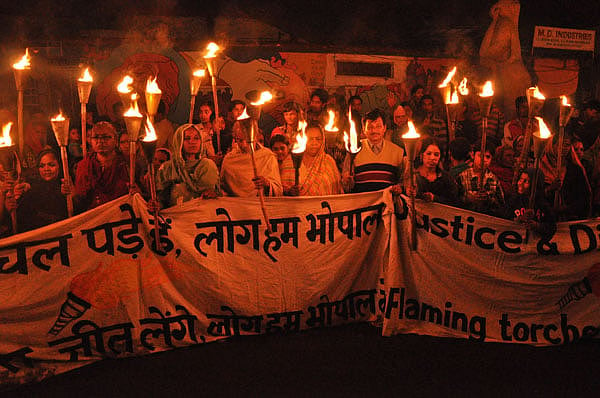
On 15 November, Premlata Chaudhary, along with four other women, broke her protest fast at Delhi's Jantar Mantar, after being assured by the Union Minister of Chemicals and Fertilisers that the government will increase compensation for the survivors of the Bhopal gas tragedy. The issue of compensation, however, represents just one of the many historical wrongs that Bhopal survivors have had to endure.
Chaudhary was among the thousands in Bhopal whose life was profoundly impacted by the release of methyl isocyanate into the air on the intervening night of 2 and 3 December 1984 from Union Carbide's pesticides factory. She still suffers from its ill-effects thirty years on. Her family members were also badly affected. One of her sons died some years later after suffering from convulsions, and her husband, an engine driver, had to give up work as he suffered from breathlessness. The fate of her mother who was visiting her on that night is unknown as she is still missing.
In another form of protest, 67-year-old Chaudhary, along with other survivor-activists, had chained herself to the gates of the Dow Chemical office in Mumbai on 17 October. Dow Chemical bought 100 percent of the assets of Union Carbide Ltd in 2001, but it denies responsibility for Carbide's liabilities. Chaudhary's health condition was doubly impacted: not only did she inhale the deadly gas, but she had also been drinking poisoned water for many years. Like many of Bhopal's communities, she is a victim of the 'second tragedy' – the contamination of ground water by the leaching of toxic chemical waste that was dumped at the abandoned factory site, which Dow Chemical has refused to clean up.
Ironically, even as Chaudhary and others were protesting against Dow Chemical in Mumbai, they were unaware that former CEO of Union Carbide, Warren Anderson, had died a few weeks earlier in his luxurious US home where he had avoided the public limelight. Anderson, facing criminal charges of culpable homicide not amounting to murder, was declared an absconder for his refusal to come to the Bhopal sessions court despite several court orders.