
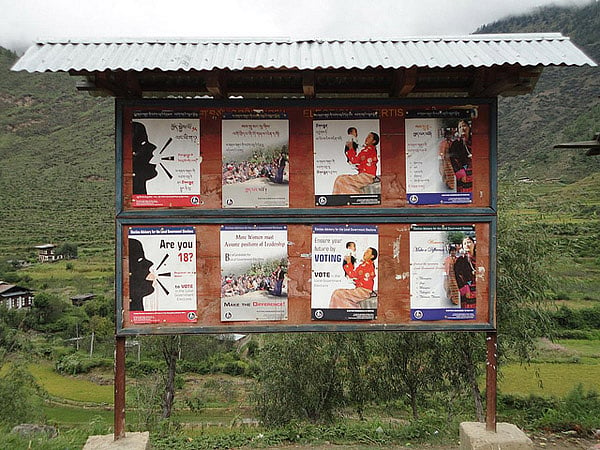
On 18 October 2018, Bhutanese voters will go to the polls in the country's third parliamentary election to decide which party will lead the young democracy for the next five years. Regardless of the outcome, we can be certain that Bhutan will see a new party in Parliament. As Bhutan follows a run-off system for electing members of its lower house, the National Assembly, only two parties proceed from the primary to the secondary round. In a record turnout of over 54 percent of the registered voters at the primaries on 15 September, the ruling People's Democratic Party's (PDP) third place was seen as a major upset, leaving the Druk Phuensum Tshogpa (DPT) and newcomers Druk Nyamrup Tshogpa (DNT) in the final round.
In Bhutan's first-past-the-post system, candidates of the two parties that lead the run-off election are pitted against each other across the country's 20 districts, each of which has between two and seven constituencies. The party that commands the majority in the 47-seat Parliament will put forward its leader as the prime ministerial nominee, who is then appointed by the King of Bhutan. The electoral system not only forces the National Assembly to accommodate only two parties at a time, but also has provisions discouraging the creation of new political forces. For instance, a party must present a candidate for every constituency throughout the country in order to participate in the election.
Shifting currents
Many pundits had expected the ruling People's Democratic Party to breeze past the primaries due to its popularity for having jump-started economic growth and resolved the shortage of Indian Rupee in its reserves, critical for the country's trade. However, a strong anti-incumbent sentiment appears to have shifted the currents. Druk Nyamrup Tshogpa, a party registered just prior to the 2013 elections, garnered 32 percent of votes in the primary round, with Druk Phuensum Tshogpa coming a close second with 31 percent. The Druk Nyamrup Tshogpa received much exposure due to its performance at constituency-level debates and has risen to popularity with its focus on healthcare issues.