
On 4 December, the royal government of Bhutan undertook perhaps its most high-profile discussion ever of the country's human-rights record, in Geneva at the UN Human Rights Council (HRC). Simultaneously, a group of resettled Bhutanese refugees in Europe were likewise undertaking perhaps the most high-profile public demonstrations ever to highlight that same rights record. The occasion was Thimphu's official handover of a report on its human rights to the HRC's new Universal Periodic Review (UPR), a mechanism created in 2006 that will look at the rights records of all UN member states on a four-yearly basis. Despite decades of positioning itself as a leader of a new form of citizen-first policymaking – dubbed Gross National Happiness by the former king – the exercise in Geneva constituted the first time that Thimphu had ever engaged in an international exploration of its record on human rights, triggered both by this fresh imperative and pride in the country's status as the world's newest democracy. As officials were drawing up this first-ever report, however, many observers have been angry that Thimphu was still not treating the exercise with due diligence. Although the criticism has not been from Europe alone, in Geneva the refugees gathered to allege that, despite extending to more than 11,000 words and covering a broad synopsis of recent Bhutanese history, the report included little information about the many serious accusations that have been levelled against the royal government over the past two decades. These have ranged from charges of 'ethnic cleansing' against the Nepali-speaking Lhotshampa community of southern Bhutan during the late 1980s and early 1990s (more than 100,000 of whom subsequently lived for years in camps in southeastern Nepal); to more recent allegations of restricting the voting rights of the some 80,000 Lhotshampa that still live in Bhutan during the country's first-ever elections, held in early 2008.
In fact, contrary to the initial suggestions (including some subsequent reporting), the Bhutanese document does indeed include analysis of the Lhotshampa situation, albeit from a perspective that does little to address the underlying concerns. Under the heading of "Illegal immigration", the report contextualises those tens of thousands who were kicked out of the country as having illegally emigrated to Bhutan during the 1950s; blames the "political turmoil" of the late 1980s on vested political interests; and explains the subsequent situation surrounding the refugee camps in Nepal as due to a lack of "any screening procedures". (The "Illegal migration" section is followed by an ominous "Terrorism" section.) As correctly noted by the Geneva protestors, however, the report has nothing to say about more recent allegations, particularly those of day-to-day repression of Lhotshampa (and other minorities) of Bhutan, as well as those of many being denied the right to vote in the historic 2008 polls.
The media response to the Geneva events was telling. In Nepal, the day before the protest in Geneva was scheduled, the country's largest-circulation English-language daily, the Kathmandu Post, published a front-page story on the rationale for the demonstration. In Bhutan, on the other hand, none of the major English papers included any mention of what was taking place in Europe – on neither the report nor the protests. Two weeks earlier, the former state-run Kuensel newspaper had published a piece on the upcoming report for the UPR under the tantalising headline, "Bhutan in the hot seat". But the article's first line instead included pat references to how "When Bhutan presents its national report for the universal periodic review … the country's delegation will be commended on the successes and also have to provide clarity on, among others, some largely inaccurate claims and allegations." And so the grounds were set for what could have been a new page in dialogue over a notoriously contentious, if little discussed, issue: the dichotomy between Bhutan's positioning of itself as a progressive-though-traditional idyll, and the serious criticisms of the country's authoritarian-to-dictatorial political set-up.
Beautiful blinders
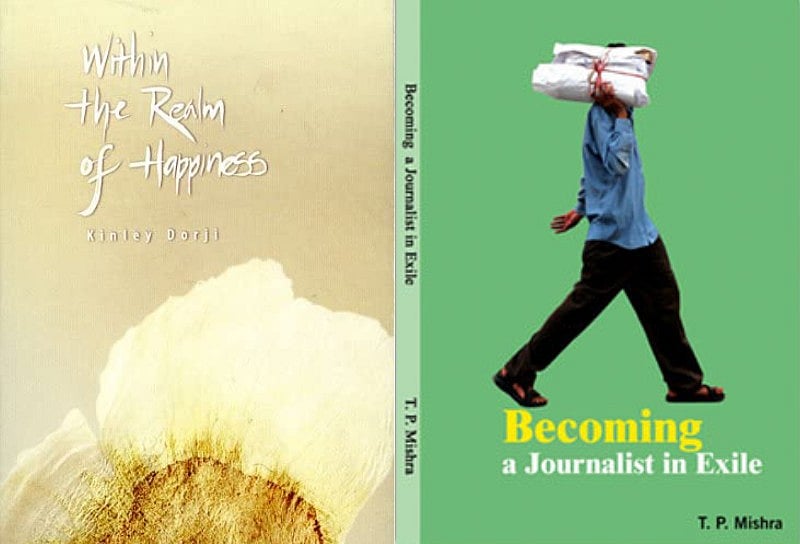
This disparity has been highlighted at the Himal office in recent months as well, as two essentially self-published Bhutan-related books have been sitting – together yet uneasily – on the editorial desk. The first of these is an achingly lyrical series of day-to-day semi-fictional vignettes written by an acclaimed former editor of Kuensel and current Information Ministry secretary; the second is a do-it-yourself handbook in the activist vein, written by a young Bhutanese journalist living in exile in Nepal. As can be adduced by their equally leading titles, as 'companion' pieces these two works stare in diametrically opposite directions, each in its own way digging a surreptitious elbow into the other's soft midriff.