
The bloody massacre in Bangladesh quickly covered over the memory of the Russian invasion of Czechoslovakia, the assassination of Allende drowned out the groans of Bangladesh, the war in the Sinai Desert made people forget Allende, the Cambodian massacre made people forget Sinai, and so on and so forth until ultimately everyone lets everything be forgotten.
– Milan Kundera, The Book of Laughter and Forgetting.
This is the quote with which Gary J Bass begins his book The Blood Telegram: India's Secret War in East Pakistan, written more than 40 years after the Liberation of Bangladesh. Now, with the events of 1971 distant enough to be revised or ignored, these lines from Kundera are apt in introducing its horrors.
There is an internet adage called Godwin's Law (or Godwin's Rule of Nazi Analogies). The rule states that the longer an online discussion gets, the more likely that a comparison will be made with Hitler or the Nazis. This is not only true of the Westerners but also true for the brown people of Southasia, where the Bangladesh genocide of 1971 happened. The failure to imagine one's own tragedies as a benchmark for human tragedies stems from a peculiar estrangement from one's past and surroundings. But something else is also at work here: it is the process by which some experiences are made more human (typically experiences of white humans) and some experiences are made mere statistics (typically those of non-white humans).
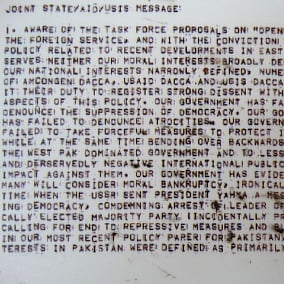
It is this alienating worldview that the global North passes on to deracinated elites of the South. This disconnection from their home-societies always makes them more predisposed to valuing certain kinds of intellectual imports over others. It is interesting that, unlike Godwin's Law, nothing from the global South is ever an analogy that comes up to represent the universally reprehensible – this in a world where the primary victims of mass violence have predominantly been from the global South. The 1971 genocide in Bangladesh, given the shorter time span in which it occurred, had a bigger impact than the one that has become the template for genocide: Bangladesh, within ten months, saw nearly half the number of death that occurred in the Holocaust during the entire Second World War. There is also enough proof that the self-proclaimed leader of the 'free' world supplied arms to the genocidal war machine in 1971, and these were actually used on the unarmed population of Bangladesh (then East Pakistan).