
Early in this slim book, author Rajinder Dudrah, a senior lecturer at the University of Manchester, quotes cultural anthropologist James Clifford: "How do different populations, classes and genders travel? What kinds of knowledge, stories and theories do they produce?" In his book, Dudrah applies these questions to Hindi cinema, using a broad definition of 'travel' to examine how contemporary Bollywood movies cross physical and cultural borders and form new relationships with the Indian diaspora while moving constantly between tradition and modernity and commenting on the ever-changing lives of Indians at home and abroad.
This is an intriguing discourse: if it is true that cinema 'travels' with its audience and with the people it represents, popular Hindi films have undoubtedly logged a high number of frequent-flier miles. However, these ideas are presented in the book in muddled and fragmented tones, with solemn scholarly writing sharing space with flippant asides. As a result, the seven chapters read like separate essays casually stitched together. It then comes as no surprise when the book ends abruptly with a quick discussion on three recent films – Delhi Belly, Singham and Zindagi na Milegi Dobara – released just in time for the author to accommodate his thoughts in a few pages.
In one chapter, Dudrah comments on the use of the India-Pakistan border in films such as Main Hoon Na and Veer-Zaara, both released in 2004. These movies, he writes, "invoke border crossing as a possibility and aesthetic pleasure that transcends easy and conservative constructions of Indians and Pakistanis in problematic binary terms." How is this achieved? Dudrah points out that Main Hoon Na offers a spin on the epic Ramayana by recasting the villain Ravana as an Indian named Raghavan who stands for an internal (rather than a foreign) threat to India's security. Further, he says, the film visually emphasises the similarities between underprivileged people on both sides of the border. Meanwhile, Veer Zaara cleverly blends elements in Indian and Pakistani music to tell the story of a love which eventually transcends the notion of borders. "The border, and the pleasure and problem of how to overcome and cross it effectively, construct an intended relationship of affect with the viewer," Dudrah writes.
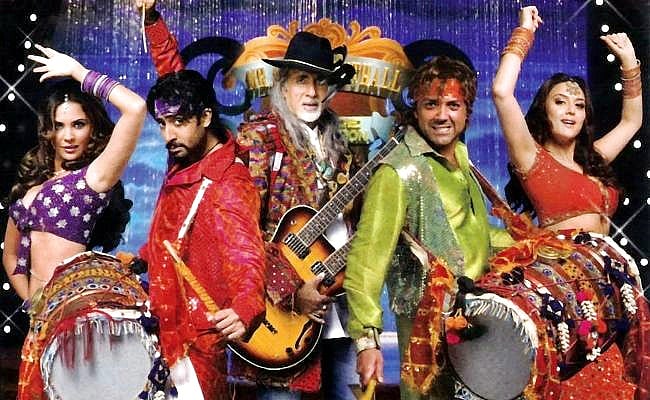
In another chapter, Dudrah looks at the Shaad Ali-directed film Jhoom Barabar Jhoom (2007), analysing its presentation of the non-resident Indians living in England and the references the film makes to Hindi cinema of an earlier time – for example, in a scene where a character named Laila is introduced, a version of the rambunctious 1980s song 'Laila O Laila' is played in the background. And the 2008 film Dostana about two men who pretend to be gay lovers (played by John Abraham and Abhishek Bachchan), is discussed in terms of the subversion of heterosexual romance in traditional Hindi movies.