
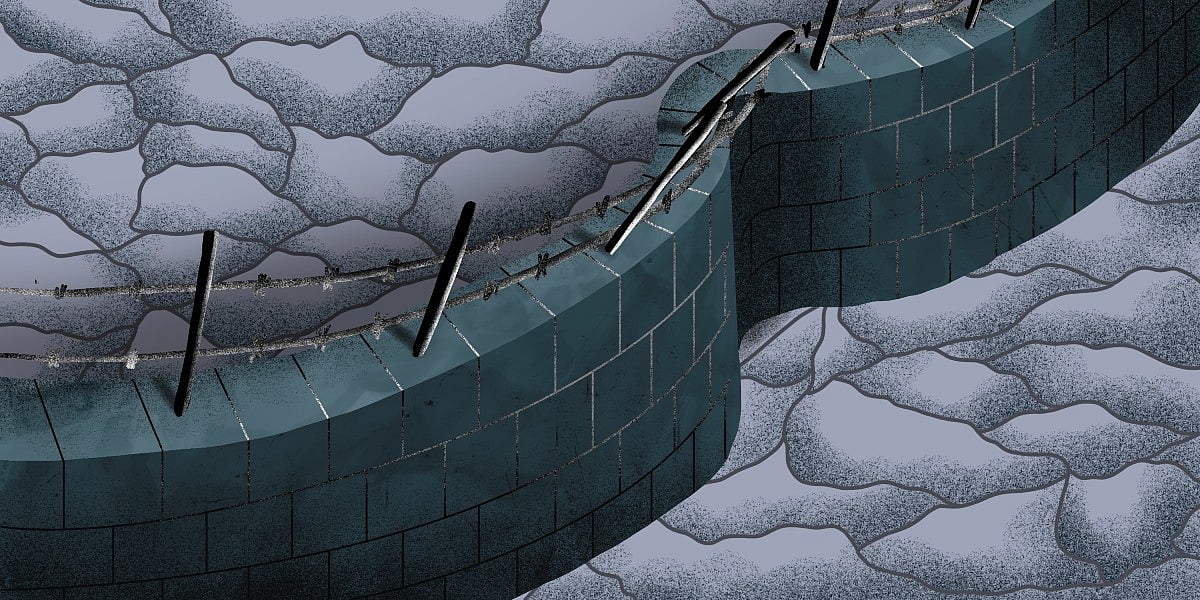
The absurdity of borders is a recurrent theme in Amitav Ghosh's 1988 novel The Shadow Lines. At three different points in the novel, three characters reflect on what borders mean to them. Before flying to Dhaka from Calcutta, the narrator's grandmother, Mayadebi, realises with some consternation that her birthplace in Bangladesh is now at odds with her Indian nationality. But what is even more incomprehensible to her is that there are no physical demarcations at the border between the two countries. "If there aren't any trenches or anything, how are people to know?" she wonders. "It'll be just like it used to be before, when we used to catch a train in Dhaka and get off in Calcutta the next day without anybody stopping us." The second reflection comes from Mayadebi's uncle, Jethamoshai, who refuses to leave Dhaka and return to Calcutta with the extended family. "Suppose when you get here they decide to draw another line somewhere? What will you do then?" he prophesies, nearly a decade before the birth of Bangladesh. The third observation comes from the narrator's friend Robi. "Why don't they draw thousands of little lines through the whole subcontinent and give every little place a new name? What would it change?" he says about the self-determination and secession movements that emerged in the decades after Partition. The three perspectives capture divergent ways to think about borders, and yet, they converge to convey their shadowy or illusory nature.
Writing more than three decades later, lawyer, journalist and author Suchitra Vijayan contends with the same arbitrariness, constructedness, and meaninglessness of borders in her debut book Midnight's Borders: A People's History of Modern India. In Vijayan's retelling, however, borders and maps are not so much shadowy and illusory but rather concrete sites of state violence. They are instruments of power wielded by nation-states with ever-increasing force to inflict an enormous degree of material, psychic and epistemic violence on border societies and the people who inhabit these liminal spaces. Between 2013 and 2019, the author travelled across some of India's most remote border towns, listening to and documenting these stories. Midnight's Borders is the outcome of her fragmented, seven-year-long journey along the 9000-mile land border that India shares with Bangladesh, China, Myanmar and Pakistan. It is a meticulously researched and incisive work of narrative journalism, a unique and expansive archive put together with empathy and care.
The act of chronicling someone else's story, however, raises the inevitable concerns about the power and ethics of documentation. Born and raised in Chennai in Tamil Nadu and currently, part of the diaspora, the context that Vijayan is writing about is far removed from her own. This is something that the author remains conscious of throughout the book. To outline her subject position vis-a-vis the people she documents, Vijayan writes herself into the narrative – documenting her ethical dilemmas, learnings and missteps as she accumulates these stories – but without centring herself. But it is her choice of narrative technique – placing people's stories at its core – which allows her to displace the dominant gaze and centre the 'periphery'. Instead of the 'mainland' scrutinising life at the 'periphery', it is the periphery that casts a critical lens at the state's violent border policies and the complicities of the mainland in sustaining them. Here, border residents are not spoken for but retain their agency to speak for themselves or respond with silence. Her role in this book, Vijayan notes, is to not "bear witness" or "give voice to the voiceless" but to "find in their articulations a critique of the nation-state". For the most part, the book adheres to this. The rare distractions in this otherwise tightly woven narrative appear when the author interjects to leave a concluding thought for the reader rather than to leave the reader to make these inferences on their own.
Mapping "a people's history"