
It's eight in the morning on the 2559th anniversary of the Buddha's birth. The lower reaches of the hilltop temple of Swayambhunath in west Kathmandu, known to tourists as the Monkey Temple, are thick with devotees. But this year they won't be able to gaze upon the 13 tiered gold rings of the 5th-century stupa. While the main structure escaped unscathed in the 7.8-magnitude earthquake that shook Nepal on 25 April, many of the smaller shrines have been destroyed, and the site is off-limits. This doesn't deter the pilgrims; if anything, their prayers and prostrations seem more fervent than ever. These expressions of abiding faith in the wake of catastrophe may be confounding, but in Nepal, many believe their fates are inscribed on their foreheads. Natural disasters, even those that kill and maim tens of thousands and obliterate hundreds of thousands of homes, are not to be blamed on the gods.
Before the enormity of the human devastation became apparent, the days following the earthquake were dominated by news of the destruction of iconic monuments in the Kathmandu Valley's seven UNESCO Monument Zones. As aftershocks rippled through the temporary encampments that filled the city's shrinking open spaces, thousands thronged Kathmandu's Basantapur Square to gawk at the piles of rubble that once were temples.
These elegant exemplars of religious architecture were the legacy of Newar artisans and their erstwhile patrons – the Malla kings of the Kathmandu Valley's medieval city states. On 25 April, the three durbar squares of Kathmandu, Lalitpur and Bhaktapur, as well as several Newar villages within the Valley, lost irreplaceable cultural treasures. Kasthamandap, from which the city of Kathmandu takes its name, and the Rato Macchindranath temple of Bungamati Village, the second home of Lalitpur's rain god, were among 59 monuments across the country that simply disintegrated. Close to 200 more were damaged. Locals whose lives were woven into these sites of worship and congregation, conservationists already struggling to stem the tide of urban encroachment and art theft, and visitors charmed by Nepal's pockets of Old World splendour, all were left bereft and despairing. With so much to rebuild, and such pressing human need, how could one even dream of restoring the glory of Nepal's golden age?
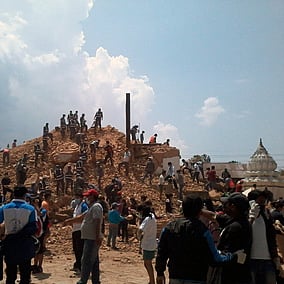
I witnessed the beginnings of an answer nearly a week after the earthquake, on my way to check on a friend in hospital who had been rescued from Lalitpur's durbar square. She was still in the intensive care unit, I learned en route, and visiting hours were restricted. As I turned my bicycle around at the intersection between Kathmandu and Lalitpur, I noticed vehicles slowing along the stretch of road overlooking the 19th-century Kalmochan temple, whose distinctive white Mughal-style dome, guarded by four ferocious griffins, had collapsed into a giant mound of rubble. Police and army personnel were silhouetted atop the ruins, and were passing bricks down, hand to dusty hand. But I could also see scores of volunteers milling about, strapping on masks and gloves. All around me, youths were stopping and entering the temple complex. Soon, the road was half blocked by parked motorcycles, their riders joining spontaneously in the clean-up of a beloved Kathmandu landmark. I locked my cycle to the railing and jumped in.