
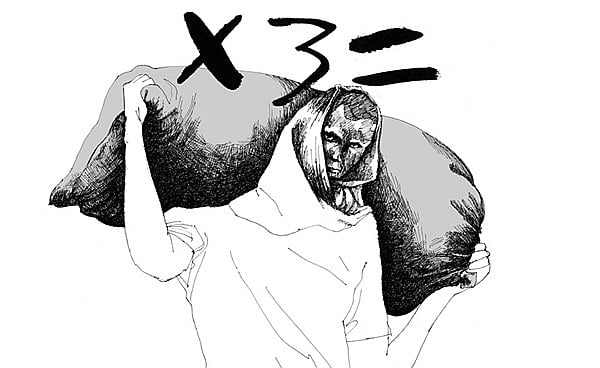
Not only Kesab, many others are in such straits. There's no food in the house, but there is a means of getting it – through his daughter. A couple of sacks of rice, two or three times her weight. Also some cash, with which they can buy a few clothes.
A year or so ago, Kesab had searched for a decent groom, so that he could give Soilo away along with a few jewels, saris and utensils. He'd been willing to spend all he had to get her married according to the scriptures and norms. But because everything he had was not much, he couldn't find an adequate recipient. Her looks are ordinary, yet she is maturing fast.
Kesab hasn't even had time to contemplate just how, in the course of this search, he's become a pauper – all from trying to provide a bit of rice for himself, his wife, the other kids and Soilo. His eldest son was married, worked as a schoolteacher at a salary of forty-three rupees. He'd died of an astonishing variety of malaria. That the fever could reach a hundred and six degrees and kill a strong young man in five days after medicines as precious as gold ran out – Kesab had only heard tales of such a miraculous malaria.
A daughter had died as well, of ordinary malaria. This kind was Kesab's intimate, resident enemy. The weapon against it, quinine, he also knew well. When she hadn't the strength to swallow a tablet, he'd mixed it in water to make a paste like glue.