
The London Borough of Tower Hamlets has featured quite heavily in the British press of late. Particular attention has been focused on the borough's colourful and eccentric mayor, Lutfur Rahman. Rahman, a solicitor of Bangladeshi heritage, has been at the centre of a media storm following the conclusions of an independent report commissioned by the Secretary of State for Communities and Local Government, after a BBC investigation on the alleged misappropriation of council funds to Bangladeshi and Somali organisations in the borough. Rahman has been accused of favouring ethnic and political allies in the distribution of grants, which he categorically denies. This episode is the latest in a series of controversies surrounding the independent mayor. Past controversies include association with Islamic 'extremist' organisations in the borough, courting criminal benefactors, public-funded luxury limos, weekly propaganda newspapers, voting fraud, polling station intimidation and refusing to answer questions from members of the public in council meetings on the grounds that it would be a violation of the mayor's 'human rights'.
Despite this, Rahman has won two successive elections by significant majorities and remains hugely popular in the borough, as he is known for delivering on his promises, particularly among the Bangladeshi community. He became Britain's first executive mayor (and the first Muslim) from a Black Minority Ethnic (BME) background when he was elected for his first term in 2010. Ironically, after having spent a lifetime working in the community in various capacities, this victory came only after a bitter fallout with the local Labour Party in the run-up to the 2010 council elections. At the heart of this remarkable outcome, which saw the gradual weakening of Labour in one of its traditional heartlands, was the borough's substantial Bangladeshi community and their three decades of struggle.
The London Borough of Tower Hamlets borders the City of London; directly to the east of the historic Roman centre of the city. The borough has long attracted migrants due to the famous London Docklands situated within its domain. Over the centuries, migrants would arrive at the docks from all over the world and find shelter and employment in the predominantly working-class communities around the area of Spitalfields. Successive migrant communities have settled in the area, including French Huguenots fleeing from religious persecution in the 16th and 17th centuries; the Russian Jewry escaping pogroms in the 19th and early-20th century; and Bangladeshis seeking employment opportunities from the mid-20th century onwards. Each community made Spitalfields their home and contributed to the landscape in varied forms by, for example, introducing distinct religious architecture, establishing commercial enterprises, and creating spaces for cultural expression through the sharing of food, language and the arts. In its most recent incarnation, the Bangladeshi community has claimed the area as its own, even officially renaming it 'Spitalfields and Banglatown'.
Banglatown
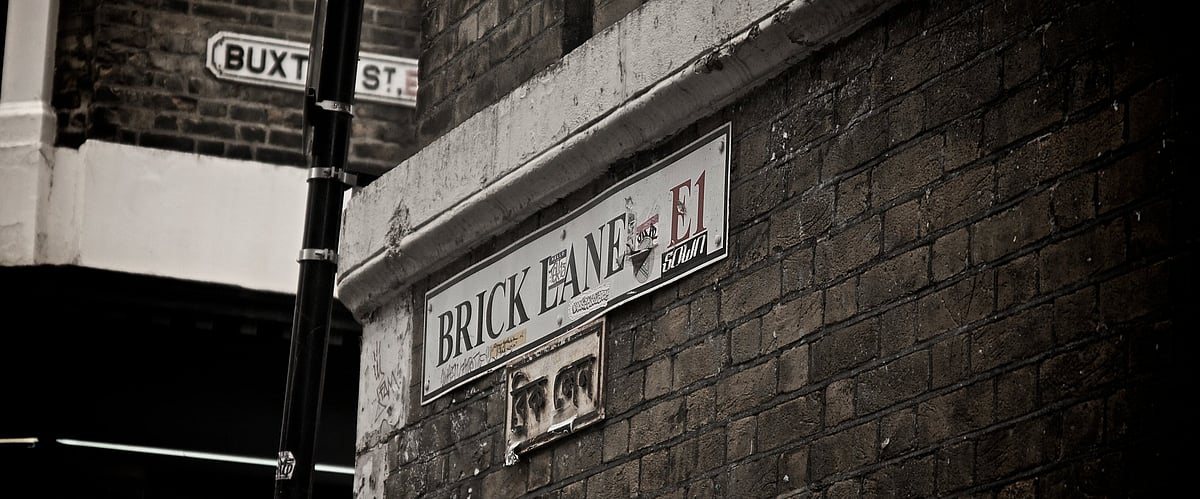
Today, a walk along Brick Lane – Banglatown's much feted thoroughfare – is a feast for the senses. The bright neon signs of Bangladeshi-owned 'Indian' restaurants line the street, serving creolised Anglo-Indian cuisine to hundreds of tourists. Overly eager and clamorous restaurant touts vie for trade on the street, pestering, cajoling and flirting with passers-by. Bangladeshi grocery stores selling freshly imported exotic fish and vegetables attract the local crowd, as do the Southasian confectionary stores and workers' cafes. A branch of Sonali Bank – Bangladesh's most popular commercial bank – is packed full of people remitting Sterling to their loved ones back home. White-bearded elderly men rush under the shadow of a great minaret in time for prayers in the grand mosque, previously a synagogue that was once a Huguenot chapel. The air is dense with the aroma of spices, sweets and paan. Street signs are written in the Bengali script. Passing conversations are not often in English. This is the 'heartland' of the British Bangladeshi community, the latest occupant of a historically diverse hub for aspiring migrants.