
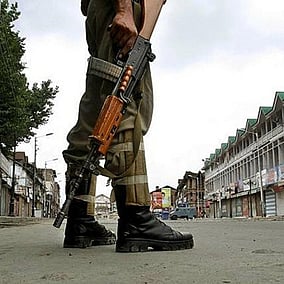
In the early 1990s, Kashmir was subject to endless curfews. The Indian Army would capture unoccupied spaces in the Valley and clog them with bunkers and checkposts. Abandoned areas were effortlessly transformed into detention centres, as if the troops were on a fill-in-the-blanks mission. Troops, bunkers and guns soon occupied social conversations and gradually permeated memories too.
On a cold, cloudy and curfewed January day in 1991, my parents decided that our small family would shift temporarily to my uncle's, whose house was just beside ours, on the edge of the main road in Naetpoor, a suburb three kilometres south of Lal Chowk, the centre of Srinagar. Earlier, in harsh winters, I'd always need to make up excuses to slip out to my uncle's house to play with my cousins. And now, though the curfew upset me, it made my ten-year-old self secretly happy too. It was a chance for me to be with my cousins who always came up with new indoor games. But as the January curfew prolonged, our food stocks diminished. The air in my uncle's house became melancholic. All the elders grew pensive. The fun and games were over for us and we gathered in the corners of the house to brood over the situation. For almost a week we ate only potatoes and boiled rice. Soon the entire onion stock was consumed; finally we found ourselves eating boiled rice with a mixture of salt and powdered red-chilli. This was the kind of food that increased my appetite. I learnt that taste actually lay in hunger and not in the food. The hungrier you were, tastier the food was. I still remember how waking up in those nights, I'd feel only the emptiness and rumble in my stomach. I'd keep turning on my sides, sniffing the strange yet lovely smell of the underside of my quilt. I would keep looking at the glowing indicator in the switchbox on the wall, aware that my cousins were doing the same and thinking the same. But in those dark, quiet and angst-ridden moments, we couldn't share with each other what was happening to each one of us.
Just before we would have begun to starve, we were overtaken by another trouble. There was some space behind my uncle's house that directly connected to the tumbledown main road. The army seemed to think that it was an area suitable for a bunker. During the last few months, before the January 1991 curfew, the insurgents in our area had been giving a tough time to the army; the troops were looking for open corners and crannies to set up bunkers to keep an eye on them.
From the attic window of my uncle's house we furtively watched a large contingent of Border Security Force (BSF) patrolling the main road of Naetpoor. The visiting Commanding Officer (CO) surveyed the houses lining the road on both sides and chose two sites for the bunker, one of which was the open space behind my uncle's house. Minutes later, we saw the troops move the large planks of wood and moss-lined stones, which had lain there idle for many years, and prepare my uncle's backyard for the bunker they were now all set to build.